
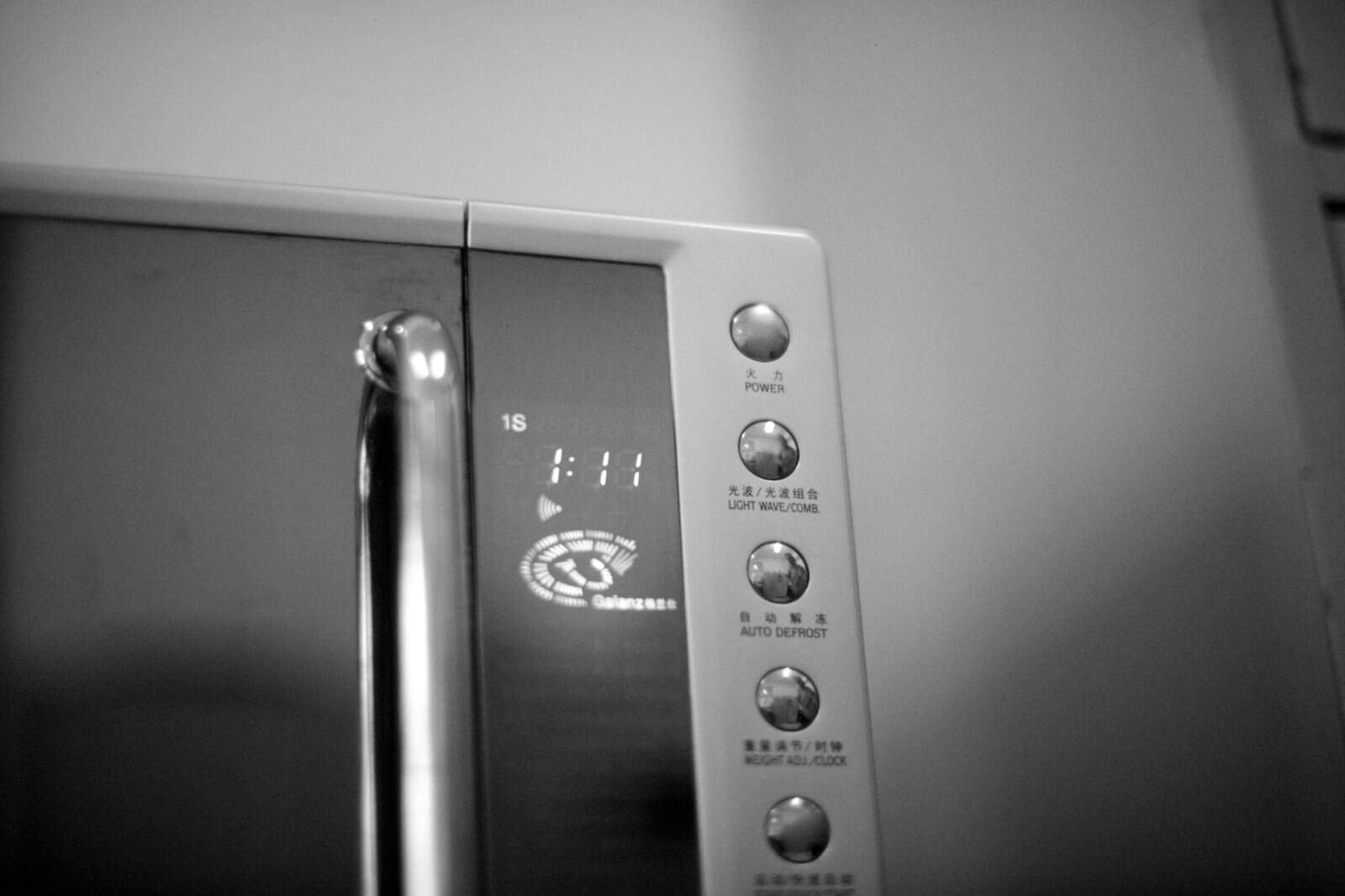
Because microwave energy forms a standing wave pattern inside the cavity, leaving hot and cold zones that no turntable fully cancels out. Asking why your microwave heats unevenly usually leads to the food rather than the appliance, since shape, density, water content and starting temperature all matter more than wattage does.
A cold center with scalding edges is the signature of the problem. Our guide to defrosting food safely covers the setting where this matters most.
Quick Answer
Standing waves create fixed hot and cold spots, and the turntable moves food through them rather than eliminating them. Fix it with lower power for longer, stirring or rearranging partway, standing time after heating, and spreading food into a ring rather than a mound. Position on the turntable matters too.
Key Takeaways
- Hot and cold zones are physics, not a fault.
- Lower power for longer beats high power in bursts.
- Standing time lets heat even out by conduction.
- A ring shape heats far more evenly than a mound.
- Off-center often beats dead center on a turntable.
- Fat and sugar superheat; water sets the ceiling.
- Stirring once partway is the highest-value habit.
| Symptom | Likely cause | Fix |
|---|---|---|
| Hot edges, cold center | Energy penetrates only so far | Ring shape, lower power, stir |
| Cold center in dense food | Density blocks penetration | Cut smaller, add standing time |
| Scalding spots in sauce | Fat and sugar exceed water’s ceiling | Stir, lower power |
| One side always colder | Standing wave pattern and position | Move food off center, rotate |
| Partly frozen after defrost | Thawed areas absorb more energy | Defrost setting, break apart, rest |
| Nothing heats much at all | Weak output or metal shielding | Water test, remove metal |
| Turntable not rotating | Drive or support issue | Rotate food manually meanwhile |
What a Standing Wave Does to Your Dinner
A microwave cavity is a metal box, and the energy inside reflects off the walls. Reflected waves overlap with incoming ones.
Where they reinforce each other, energy is high. Where they cancel, energy is low. Those zones sit at fixed positions determined by the cavity dimensions and the wavelength.
A turntable carries food through the pattern so no single spot bakes, which helps considerably and does not make the field uniform.
Models without a turntable use a rotating stirrer above the cavity to shuffle the pattern instead. Our roundup of microwave ovens covers which approach different models take.
The Food Is Usually the Variable
Penetration is limited
Microwaves heat the outer portion directly and the middle by conduction from there. Depth is why a thick mound has a cold core.
Water content drives heating
Wet food absorbs energy readily and dry food barely does. Uneven moisture means uneven heating within one plate.
Density blocks it
Dense food resists penetration. Mashed potato behaves completely differently from the same volume of loose rice.
Starting temperature compounds
Partly frozen food heats unevenly because thawed regions absorb more energy than frozen ones. Our guide to why eggs cook differently covers a related composition effect.
Fat and Sugar Break the Rules
Water sets a practical ceiling by turning to steam at its boiling point. Fat and sugar have no such limit at the same temperature.
So a sauce with a pool of fat, or a jam-filled pastry, develops spots far hotter than the surrounding food. The outside can feel warm while a pocket inside is scalding.
That is the mechanism behind burns from filled foods. It is also why stirring matters more with rich foods than with plain ones.
The same physics deforms plastic containers, which is a separate problem with the same cause. Our guide to why food browns when cooked covers what high local temperatures do chemically.
What Actually Fixes It
- Drop the power and extend the time. Lower power pulses the output, giving conduction time to even things out between bursts.
- Stir or rearrange once partway. The single highest-value habit, and most people skip it.
- Spread food into a ring. Leave the middle of the plate empty so nothing sits in the coldest, deepest position.
- Add standing time. A minute or two on the counter moves real heat inward by conduction.
- Cover it. Trapped steam heats the surface and reduces the edge-to-center gradient.
- Try off-center placement. The geometric middle is frequently a cold zone.
- Cut dense food smaller. Two thinner pieces beat one thick one every time.
Our guide to softening butter quickly covers a case where these techniques decide between soft and melted, and our roundup of meat thermometers covers checking the middle rather than guessing.
Position on the Turntable
Centering a single item feels right and is often wrong. The middle of a turntable barely moves, so anything there stays in whatever zone it started in.
Food nearer the edge travels through more of the pattern per rotation, which averages the exposure.
With two items, placing them opposite each other near the rim beats stacking or crowding them at the center.
It is worth finding your own unit’s pattern once, since cavity dimensions differ between models. Our guide to what order to cook a meal in covers sequencing when the microwave is one of several appliances running.
Finding the Cold Spots in Your Own Microwave
Spread a thin, even layer of something that shows heat across a large flat dish. Marshmallows in a grid, or a shallow layer of grated cheese, both work.
Run it on high for a short burst with the turntable stopped if your model allows, or accept the averaged version with it running.
The pattern that melts first is your hot zone map. What stays cold is where food should not sit.
That one experiment explains years of odd results. Our guide to deep cleaning a kitchen covers a good time to do it, since the test is messy.
When It Is the Appliance
Genuinely weak output is different from uneven output, and it is worth separating the two. A simple water test distinguishes them.
Heat a measured cup of cold water on high for a set time and note the temperature rise. Repeat it later, and a much smaller rise than before points at declining output.
A failing magnetron, a stuck stirrer or a turntable that has stopped rotating all produce heating complaints. The turntable is the one you can see.
Metal in the cavity shields food without sparking, which reads as a heating problem. Our guide to choosing tableware and dinnerware covers checking what a dish is actually rated for.
Related Reading
Frequently Asked Questions
Why does my microwave heat unevenly?
Microwave energy reflects off the cavity walls and forms a standing wave pattern with fixed hot and cold zones. A turntable carries food through that pattern rather than eliminating it. Food shape, density, moisture and starting temperature then decide how visible the unevenness is.
Why is the middle of my food still cold?
Microwaves heat the outer portion directly and the center only by conduction from there, so penetration depth limits what a thick mound can do. Spread food into a ring with the middle of the plate empty, and add standing time after heating.
Does lower power actually help?
Yes. Lower power settings pulse the output rather than reducing it, which gives heat time to conduct inward between bursts. Longer at lower power produces a more even result than a short blast on high, especially with dense food.
Why are some spots scalding hot?
Water sets a practical ceiling by turning to steam at its boiling point, while fat and sugar have no such limit at that temperature. A pool of fat or a jam filling can reach far hotter than the food around it, which is why filled foods cause burns.
Should food go in the center of the turntable?
Often not. The middle of a turntable barely moves, so anything there stays in whatever zone it started in. Food nearer the rim travels through more of the pattern per rotation. With two items, place them opposite each other near the edge.
How do you find the cold spots?
Spread a thin even layer of marshmallows or grated cheese across a large flat dish and run a short burst on high. What melts first maps your hot zones, and what stays cold shows where food should not sit. Expect a mess.
Is my microwave getting weaker?
Test it rather than guess. Heat a measured cup of cold water on high for a set time and note the temperature rise, then repeat the same test later. A much smaller rise than before points at declining output rather than uneven heating.
Can metal cause a heating problem without sparking?
Yes, and it is easy to miss. Metal reflects microwave energy, so a metal bowl or a foil-lined package shields its contents. Nothing sparks and nothing looks wrong, but the food comes out cold in the middle.
