
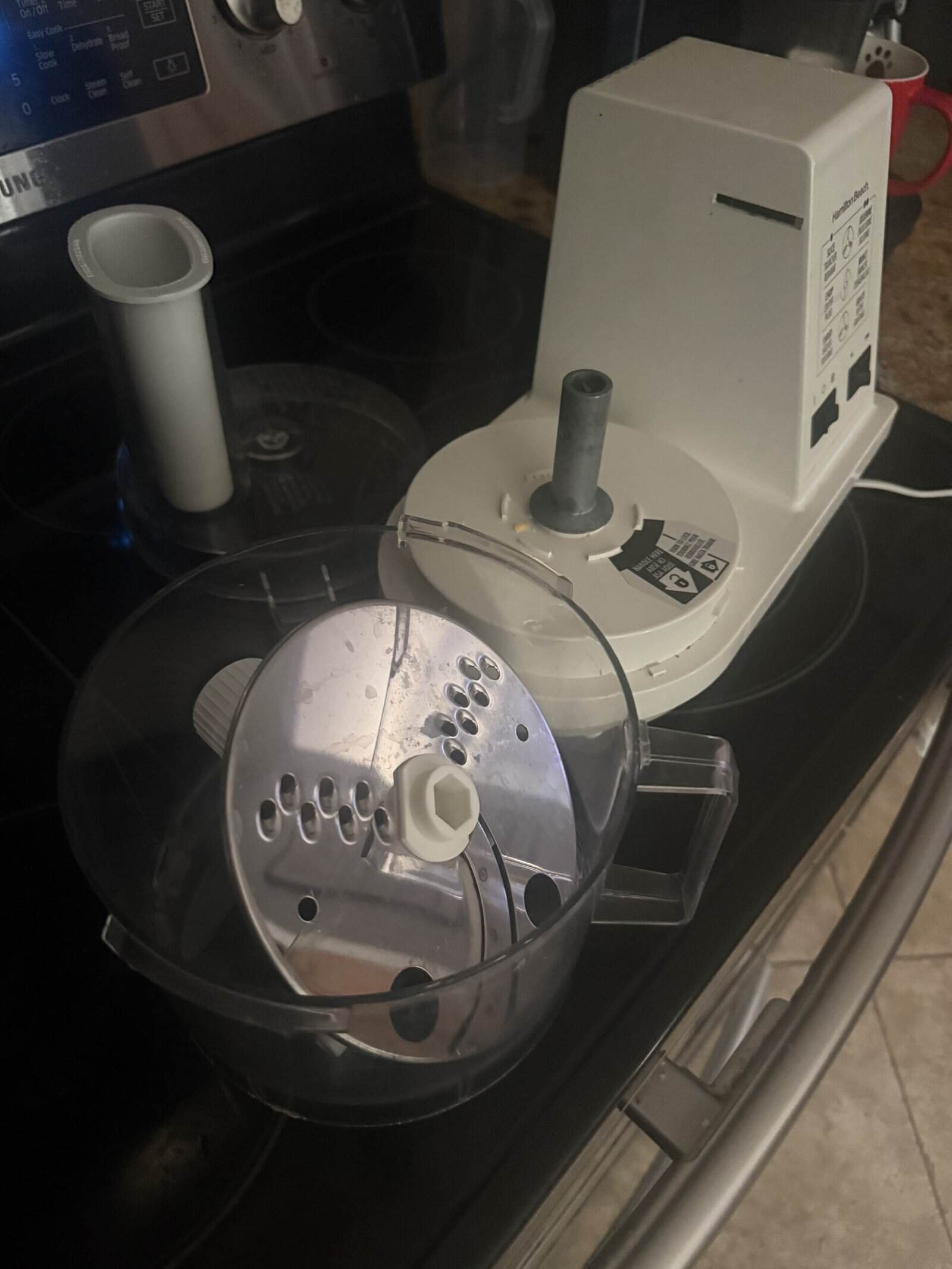
Shredding cheese is the job most people buy a food processor for and the one most buying guides barely mention, because they focus on motor power and the chopping blade. Neither matters much here. Shredding runs off a disc that sits at the top of the bowl, and the variables that decide whether it works are disc quality, feed tube width, and whether the cheese is cold enough.
Soft cheese gums the disc regardless of how good the machine is, which is a technique problem rather than an equipment one. Our comparison of blenders and food processors covers which tool does what.
Quick Verdict
A full-size processor with a reversible shredding disc and a wide feed tube handles cheese and vegetables together. Chill the cheese first and the machine matters far less than people expect.
Key Takeaways
- Shredding uses a disc, not the S-blade most guides discuss.
- Cold cheese shreds cleanly; room-temperature cheese smears.
- Feed tube width decides how much prep cutting you do.
- Reversible discs give coarse and fine from one part.
- Bowl capacity fills faster with shredding than chopping.
How We Picked
Machines are grouped by how they handle disc work rather than by motor wattage, since shredding is not a power-limited task on any full-size processor. Feed tube dimensions and disc options carry the most weight, followed by how many parts need washing.
Selections reflect documented features. Descriptions come from product research except where personal use is stated directly.
1. A Full-Size Processor With a Reversible Disc, Best Overall
Why It Stands Out
A reversible disc gives coarse shredding on one face and fine on the other, which covers cheese for melting and cheese for topping without a second part to store.
Full-size bowls also matter more for shredding than chopping, since shredded cheese takes up considerably more volume than the block it came from.
Worth Knowing
Full-size machines take real counter or cupboard space, and the bowl, lid, disc, and pusher all need washing.
Discs are sharp on both faces and are the part most likely to cut you during cleanup. Our roundup of food processors under seventy-five dollars covers the budget end.
This suits regular cheese and vegetable prep. Skip it if you shred occasionally.
2. A Wide Feed Tube Model, Best for Whole Blocks
Why It Stands Out
A feed tube that takes a whole block or a large piece removes the prep cutting that otherwise eats the time the machine was meant to save.
The same tube handles whole tomatoes and larger vegetables, which is where the width earns its place beyond cheese.
Worth Knowing
Wide tubes give less control over how produce sits, so slices can come out uneven compared with a narrow chute.
Some machines offer both a wide and a narrow insert, which is the better arrangement. Our guide to cleaning a cutting board covers the prep surface.
This suits blocks and large produce. Skip it if precision slicing matters more.
3. A Compact Processor, Best for Small Batches
Why It Stands Out
A smaller machine is quicker to get out and quicker to wash, which for a cup of shredded cheese is the difference between using it and grating by hand.
Storage is also considerably easier in a kitchen where cupboard space is the constraint.
Worth Knowing
Many compact models are choppers without disc attachments at all, so shredding capability needs checking rather than assuming.
Small bowls fill fast with shredded cheese. Our roundup of vegetable peelers covers the chopping-only versions.
This suits small kitchens and small batches. Skip it if you shred in quantity.
4. A Model With Multiple Disc Options, Best Versatility
Why It Stands Out
Separate coarse, fine, slicing, and julienne discs cover far more than cheese, and once the machine is out anyway the additional prep is nearly free.
Adjustable slicing thickness is the feature people use most after shredding.
Worth Knowing
More discs means more sharp parts to store safely and more that can go missing.
Extra discs frequently go unused, so be honest about which you will reach for. Our roundup of mandoline slicers covers the dedicated alternative.
This suits varied prep. Skip it if cheese is the only job.
5. A Dishwasher-Safe Model, Best Cleanup
Why It Stands Out
Cheese residue on a disc is unpleasant to clean by hand and the disc is the sharpest part in the sink, so dishwasher-safe parts remove both problems at once.
A machine that is quick to clean gets used for the jobs it should be used for.
Worth Knowing
Motor bases are never dishwasher safe, and some lids with electronics or seals are not either. Check which parts qualify rather than assuming all of them.
Repeated hot cycles can cloud plastic bowls over time. Our note on whether knives belong in the dishwasher covers the limits.
This suits frequent use. Skip it if you prefer hand washing anyway.
6. A Stand Mixer Attachment, Best If You Own One
Why It Stands Out
A shredding attachment for a stand mixer already on the counter avoids buying and storing a second appliance entirely.
Shredded output drops straight into whatever bowl you place underneath rather than filling a processor bowl.
Worth Knowing
These only make sense if you already own the mixer, and attachment quality varies considerably between brands.
They also do nothing for chopping or pureeing, so this is a shredding solution rather than a processor substitute.
This suits existing stand mixer owners. Skip it as a standalone purchase.
Options at a Glance
| Type | Cheese capacity | Prep cutting needed | Cleanup |
|---|---|---|---|
| Full-size, reversible disc | Large | Little | Four parts |
| Wide feed tube | Large | Least | Four parts |
| Compact | Small | More | Fewer parts |
| Multiple discs | Large | Little | Most parts |
| Dishwasher safe | Varies | Varies | Easiest |
| Mixer attachment | Unlimited | Some | Attachment only |
What I Use Mine For
Mine is a full-size Hamilton Beach, and what actually goes through it is vegetables and cheese. That is the whole workload, and it is the reason a full-size bowl made sense rather than something smaller.
Cheese and vegetables are the two jobs where a processor clearly beats doing it by hand, and both fill a bowl quickly, which is what a small machine would struggle with. For a cup of something I would not bother getting it out.
What I would say to anyone deciding is that the size question comes down to what you put through it. Mine earns the counter space because it does two things regularly rather than one thing occasionally.
What I cannot compare is compact processors, mixer attachments, or multi-disc sets, since I have only run the one machine. Those sections come from research rather than from things I have used.
Getting Clean Shreds
Chill the cheese first
Thirty minutes in the freezer firms up soft and semi-soft cheese enough to shred cleanly instead of smearing. This matters more than the machine.
Cut to fit the tube
Blocks trimmed to slide down without forcing shred more evenly, since a jammed piece stops turning against the disc.
Light pressure on the pusher
Steady and gentle beats pushing hard. Force compacts cheese against the disc and produces clumps rather than strands.
Empty before it packs
Shredded cheese expands considerably, and a bowl filled to the disc stops the shreds clearing. Our note on storing cheese covers what to do with the output.
What to Look For
Does it come with a shredding disc?
Not every processor does, particularly smaller models sold as choppers. This is the first thing to verify.
How wide is the feed tube?
Width decides how much cutting you do before the machine starts, which is where the convenience is won or lost.
Reversible or single-sided?
A reversible disc gives coarse and fine from one part, which is fewer things to store and lose.
How many parts get washed?
Bowl, lid, disc, and pusher on most machines. Dishwasher-safe parts matter here more than in most categories, since the disc is sharp.
Common Mistakes to Avoid
Shredding room-temperature soft cheese
It smears and clogs the disc regardless of the machine. Chilling first is the fix.
Forcing the pusher
Pressure compacts cheese into clumps and strains the motor. Gentle and steady produces better shreds.
Overfilling the bowl
Shreds need somewhere to go. A bowl packed to the disc stops the process rather than slowing it.
Buying on motor wattage
Shredding is not power-limited on a full-size machine. Disc quality and tube width matter far more than watts. Our guide to dishwasher-safe cookware covers the specs that count.
Recommended Reading
See our roundup of box graters, our note on cheese slicers, our guide to cutting boards, and a roundup of knife storage.
Cheese Shredding FAQ
Can any food processor shred cheese?
Only those that include a shredding disc, which is not universal. Smaller machines sold as choppers often have an S-blade alone, and that produces a paste rather than shreds. Check the attachments before buying for this job.
Why does my cheese smear instead of shredding?
It is too warm. Soft and semi-soft cheese needs about thirty minutes in the freezer to firm up before shredding, and that single step matters more than which machine you own.
Coarse or fine disc for cheese?
Coarse suits melting, since larger shreds hold their shape and melt evenly. Fine suits topping and finishing where you want the cheese to disappear into the dish. A reversible disc gives you both.
Is a food processor better than a box grater?
For quantity, considerably. For a small handful, a box grater is faster once you account for washing four processor parts. The processor wins when you are shredding enough to justify getting it out.
Can I shred hard cheese like parmesan?
Hard cheeses shred well and put more strain on the motor. Some people prefer the S-blade for parmesan, breaking it into chunks first, which produces a finer texture than a shredding disc gives.
Does pre-shredded cheese melt differently?
Commercially shredded cheese is usually coated with an anti-caking agent, which affects how it melts. Shredding your own avoids that, and is one of the more common reasons people buy a processor for this job.
How do I clean a shredding disc safely?
Handle it by the center hub rather than the edge, and use a brush rather than a cloth so your fingers stay clear. Rinsing immediately stops cheese drying into the perforations, which is much harder to remove later.
What size processor do I need?
Size to what you put through it. Shredded cheese takes considerably more volume than the block, so a bowl that seems generous fills faster than expected. Full-size makes sense for regular cheese and vegetable prep together.
