
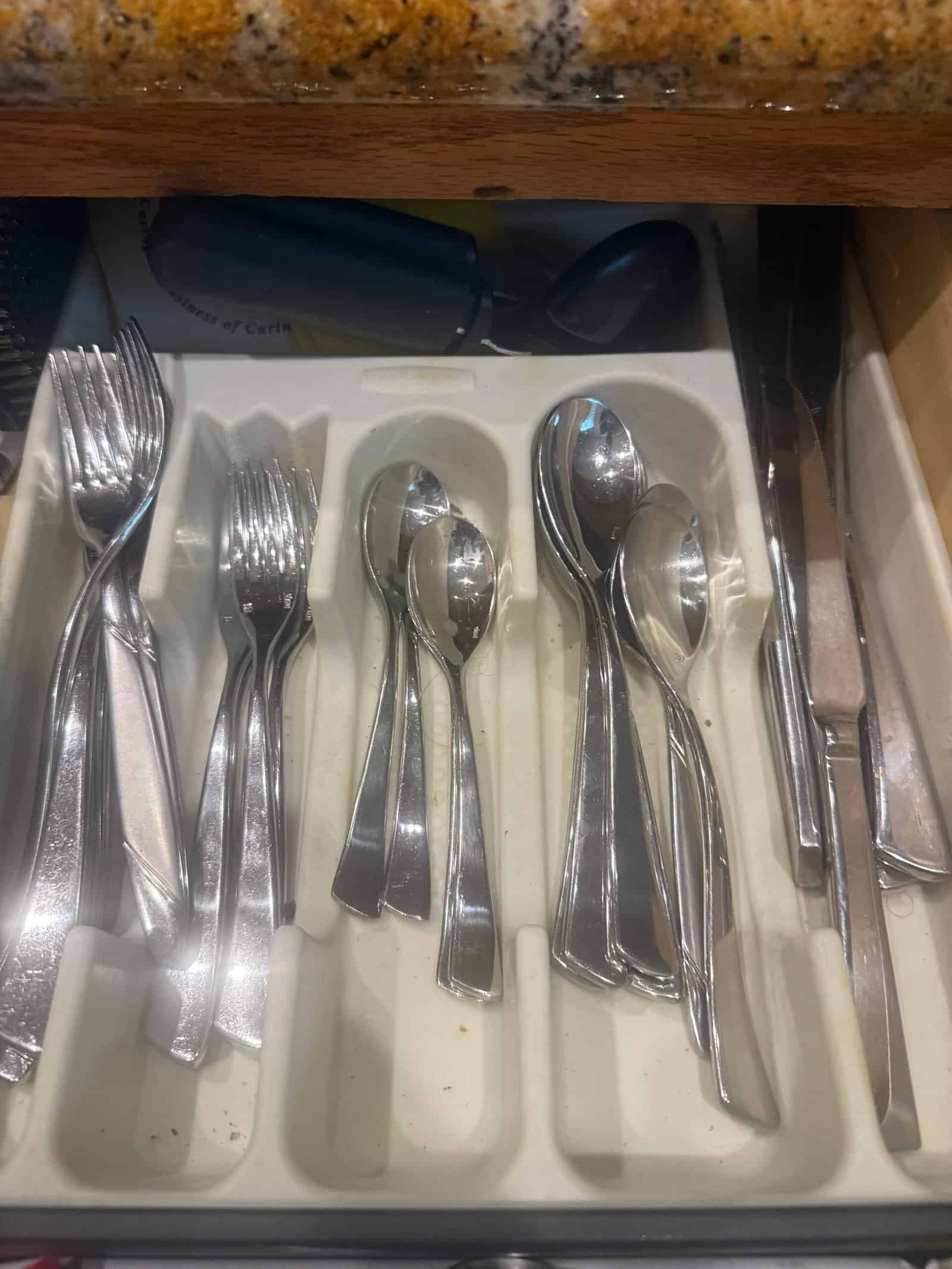
A silverware organizer is sized by your drawer before it is sized by your cutlery, and getting that order wrong is why so many end up returned. Measure the drawer’s interior width, depth, and usable height first, then find a tray that fits it. A tray chosen for its compartment layout and then wedged into a drawer that is an inch too narrow will not close properly, and a drawer that does not close is worse than no organizer at all.
The second thing that decides satisfaction is what the tray does not hold. Most are laid out for forks, spoons, and butter knives in matched sets, and everything else in the drawer competes for whatever space is left, which in a small kitchen is the binding constraint rather than counter or cabinet space. The wider approach is covered in working through kitchen organization.
Quick Verdict
Measure the drawer, then buy an expandable or modular tray so the fit is adjustable rather than fixed. Plan separately for steak knives and gadgets, because standard trays do not accommodate them and pretending otherwise is how you end up with a second drawer of loose items.
Key Takeaways
- Drawer interior dimensions decide the tray, not the other way round
- Usable height matters as much as width, since the drawer has to close
- Standard trays hold matched flatware and little else
- Steak knives rarely fit and usually need their own home
- Expandable and modular designs adapt to awkward drawer sizes
- Non-slip feet stop the tray sliding every time the drawer opens
How We Picked
Fit adaptability came first. Drawer sizes vary enormously between apartments and builders, and a fixed tray either fits or it does not. Expandable and modular options solve that outright, which matters more than compartment count.
Slot practicality was second. Compartments sized for a specific utensil look tidy in photographs and constrain what you can actually store. Trays with a mix of narrow slots and at least one wider open bay handle real drawers better than perfectly divided ones.
Stability finished the list. A tray that slides forward every time the drawer opens throws its contents together, and non-slip feet or a snug fit prevent that. It is a small detail with daily consequences.
What Is Actually in My Drawer
I use an insert for a household of three, and it holds all the silverware plus the odds and ends that accumulate in a cutlery drawer, including a bottle opener and a can opener. That mix is the normal case rather than the exception, and a tray that only accounts for forks and spoons ignores most of what people actually keep there.
What it does not hold is steak knives, and that is the honest friction. They live somewhere else, which is a small daily annoyance rather than a real problem, but it is the thing I would tell someone to check before buying. Steak knives are longer and thicker than butter knives, and standard trays are not laid out for them.
Drawer space is the constraint in my kitchen generally. Counter, closet, and pantry space are all reasonable, and drawers are what runs out, which is why an organizer has to earn its footprint rather than just look neat.
My experience covers one insert in an apartment kitchen drawer for a three-person household. It does not cover in-drawer knife blocks, expandable trays, or bamboo versus plastic longevity, since I have used one type.
1. The Expandable Tray
Why It Stands Out
A tray that slides wider or narrower fits drawers that fixed trays miss. Since drawer widths vary so much, this removes the main reason organizers get returned, and it lets you set the fit so nothing shifts.
Worth Knowing
The expansion mechanism takes up space and creates a gap or a sliding seam where crumbs collect. Expandable trays are also usually shallower than fixed ones, which matters if your drawer is deep and you hoped to use the height.
Right for non-standard drawers and anyone who has already returned one tray. Skip it if a fixed tray fits your drawer well.
2. The Modular Divider Set
Why It Stands Out
Separate bins arranged to suit the drawer let you build the layout around what you own, including a wider bay for gadgets that standard trays have no slot for. Rearranging later costs nothing.
Worth Knowing
Individual bins slide unless the drawer is packed or the bins have grip pads. They also leave gaps between units where small items migrate, which is untidy in a way a single tray is not.
Right for drawers holding a mix of cutlery and tools. Skip it if you want everything held in one fixed position.
3. The Bamboo Tray
Why It Stands Out
Bamboo is rigid, does not flex when lifted, and looks considerably better than molded plastic in a drawer you open often. It also holds its shape over years rather than warping under weight.
Worth Knowing
Wood and moisture are a poor combination, and cutlery put away damp will mark it over time. Bamboo trays are also almost always fixed size, so the drawer has to match, and they cost more than plastic equivalents.
Right for a drawer you want to look good and cutlery you dry properly. Skip it if things go away wet.
4. The Deep Drawer Two-Tier Organizer
Why It Stands Out
Deep drawers waste vertical space with a standard tray. A two-tier design puts a sliding upper tray over a lower bay, roughly doubling what the drawer holds without taking more room in the kitchen.
Worth Knowing
Everything in the lower level requires moving the top tray, so it suits things you reach for less often. Two tiers also need genuine depth, and a drawer that merely looks deep often is not once the runners are accounted for.
Right for deep drawers in small kitchens. Skip it in shallow drawers, where it will stop the drawer closing.
5. The In-Drawer Knife Organizer
Why It Stands Out
This is the fix for the utensils a silverware tray will not take. A dedicated insert holds steak knives and larger blades flat and separated, protecting edges and keeping them out of a drawer where they slide loose among the forks.
Worth Knowing
It occupies drawer space that could hold something else, which is a real cost where drawers are the binding constraint. A wall-mounted magnetic strip solves the same problem without using a drawer at all, if you have wall space to give.
Right for households with steak knives and no block. Skip it if a wall strip or a block already handles them.
6. The Compact Tray for Small Drawers
Why It Stands Out
Narrow trays designed for apartment drawers fit where standard organizers cannot, and they accept that you are storing cutlery for a few people rather than a full set for twelve. Fewer, better-sized compartments beat many cramped ones.
Worth Knowing
Capacity is genuinely limited, and there is rarely room for anything beyond flatware. If your drawer also holds tools and gadgets, a compact tray forces them elsewhere.
Right for small apartment drawers and small households. Skip it if the drawer is also your gadget drawer.
Silverware Organizers at a Glance
| Type | Fits odd drawers | Holds gadgets | Best for |
|---|---|---|---|
| Expandable tray | Yes | Limited | Non-standard widths |
| Modular bins | Yes | Yes | Mixed contents |
| Bamboo tray | No | Limited | Appearance and rigidity |
| Two-tier | Needs depth | Yes, lower bay | Deep drawers |
| In-drawer knife insert | Varies | Knives only | Steak knives |
| Compact tray | Small drawers | No | Apartments |
What to Look For in a Silverware Organizer
Have you measured the drawer inside?
Interior width, front-to-back depth, and usable height above the runners. Height is the one people skip, and it is what stops the drawer closing when a tray is slightly too tall for the opening.
What else lives in that drawer?
Most cutlery drawers hold openers, peelers, and other small tools alongside the flatware. A tray with only utensil-shaped slots pushes all of that somewhere else, so check there is at least one open bay.
Where will the steak knives go?
Standard trays do not fit them, and the answer is either a dedicated insert, a separate drawer, a block, or a wall strip. Deciding before you buy is easier than discovering it afterwards.
Will it stay put?
A tray that slides forward when the drawer opens undoes its own organizing. Non-slip feet, a snug width, or packing the drawer well all prevent it.
One Tray vs Modular Bins
Where a single tray wins
Nothing shifts, nothing gaps, and everything has one fixed home. In a drawer that holds only flatware, a well-fitted tray is tidier and easier to clean than several separate pieces.
Where modular wins
Flexibility for drawers holding a mix of things, and the ability to reconfigure when what you own changes. In a small kitchen where drawer space is the constraint, being able to reshape the layout is worth the seams and the occasional sliding.
What Trips People Up
Buying before measuring
The single most common return in this category. Drawer interiors differ by inches between kitchens, and a tray that is close does not fit.
Forgetting the drawer has to close
Height is measured to the underside of the counter or the drawer above, not to the top of the drawer sides. A tray an inch too tall makes the drawer unusable.
Assuming steak knives will fit
They generally do not. Longer blades and thicker handles need their own arrangement, and standard trays are laid out for butter knives.
Overfilling a small drawer
Where drawer space is the binding constraint, an organizer only helps if the contents fit its layout. Reducing what lives in the drawer does more than a better tray, and a pared-back apartment kitchen is the underlying fix.
Recommended Reading
- flatware sets and how they affect storage
- wall strips that free up drawer space
- keeping the knives you store in good order
- turntables for cabinet organization
- the wider organization approach
- gear suited to limited apartment storage
- organizers for other kitchen drawers
Frequently Asked Questions
How do I measure a drawer for an organizer?
Measure the interior width at the narrowest point, the depth from front to back inside the drawer, and the usable height from the drawer base to whatever the drawer closes under. Height is the measurement most often missed.
Will steak knives fit in a silverware tray?
Usually not. Standard trays are laid out for butter knives, and steak knives are longer with thicker handles. Most households end up with a dedicated insert, a block, a wall strip, or a separate drawer.
Bamboo or plastic?
Bamboo is more rigid and looks better; plastic tolerates moisture and costs less. If cutlery goes away damp, plastic is the safer choice, since wood marks and can warp over time.
Are expandable organizers stable?
Reasonably, once set to the drawer width, though the sliding seam collects crumbs and they are typically shallower than fixed trays. The tradeoff is worth it when a fixed tray will not fit.
How do I stop the tray sliding around?
Non-slip feet, a fit snug enough that there is no travel, or adhesive grip pads underneath. A tray with room to move will slide forward every time the drawer opens.
How many people does a standard tray hold cutlery for?
Most standard trays are laid out for four to six place settings, which suits a small household comfortably. Larger sets need either a wider tray, a second drawer, or storing the overflow elsewhere.
Can I use a silverware tray in a deep drawer?
You can, though it wastes the height. Two-tier organizers use deep drawers properly, provided the depth is genuine once the runners and the closing clearance are accounted for.
