
People searching for dialogue clarity are usually describing one of two things. Either speech itself sounds muddy and hard to make out, or speech is perfectly clear but keeps getting buried when music and effects surge over it.
Those need different answers. The first is about drivers and processing. The second is about dynamic range, and a soundbar with excellent speech reproduction can still leave you reaching for the remote through a whole film. Our guide to choosing a soundbar covers the wider decision.
What Each Feature Solves
| Feature | Solves | Notes |
|---|---|---|
| Center channel | Muddy speech | Dedicated driver for dialogue |
| Dialogue enhancement | Muddy speech | Boosts speech frequencies |
| Night mode | Volume swings | Compresses dynamic range |
| Volume leveling | Volume swings | Evens out across content |
| Separate subwoofer | Neither directly | Frees the bar to focus on mids |
| Wired connection | Both, indirectly | Better signal than Bluetooth |
The short version: if speech is unclear you want a center channel and dialogue enhancement. If speech is clear but keeps disappearing, you want night mode or volume leveling.
How We Picked
Bars are grouped by which of the two problems they address, since buying for the wrong one is the most common mistake in this category. Center channel presence and dynamic range controls carry the most weight.
Selections reflect documented specifications and features. Descriptions come from product research except where personal use is stated directly.
1. A Bar With a Dedicated Center Channel, Best Overall
Why It Stands Out
A driver dedicated to the center channel handles dialogue on its own rather than sharing duty with music and effects, which is the most direct structural fix for unclear speech.
Three-channel bars are the entry point for this and the difference against a two-channel bar is noticeable on speech-heavy content.
Worth Knowing
More channels means a wider bar, which needs matching space on the stand or wall.
A center channel does nothing for volume swings. Our roundup of soundbars for small living rooms covers fitting one.
This suits muddy dialogue. Skip it if speech is already clear and the issue is volume.
2. A Bar With Night Mode, Best for Volume Swings
Why It Stands Out
Night mode compresses dynamic range, lifting quiet passages and reducing loud ones, which directly addresses music and effects overwhelming speech.
It is the single most useful setting for anyone constantly adjusting volume through a film.
Worth Knowing
Compression flattens the impact of big moments, which is the point and also a real loss on content where that impact matters.
Implementations vary considerably in how aggressive they are. Our note on why music is louder than dialogue covers the underlying cause.
This suits late-night viewing and dynamic films. Skip it if you want full impact.
3. A Bar With a Separate Subwoofer, Best Balance
Why It Stands Out
Moving bass to a separate cabinet lets the bar’s drivers concentrate on mid frequencies, which is where speech lives, rather than trying to produce everything at once.
That frequently improves perceived clarity even though nothing about the speech processing changed.
Worth Knowing
A subwoofer needs floor space and power, which not every room accommodates.
An overly loud sub makes dialogue worse rather than better. Our note on whether you need a subwoofer covers the question properly.
This suits rooms with space. Skip it in an apartment with neighbors below.
4. An All-in-One Bar, Best Simplicity
Why It Stands Out
A single unit with no separate components is straightforward to place, needs one power outlet, and involves no pairing between boxes.
Modern all-in-ones handle dialogue considerably better than the flat panel speakers they replace, which is the comparison that matters for most buyers.
Worth Knowing
Producing all frequencies from one cabinet limits how much separation is achievable between speech and everything else.
Dynamic range handling on these varies widely. Our comparison of soundbars and Bluetooth speakers covers the format.
This suits small rooms and simple setups. Skip it if you want maximum separation.
5. A Bar With HDMI ARC, Best Signal Path
Why It Stands Out
A wired HDMI connection carries the full audio signal without the compression a Bluetooth link applies, and it passes surround formats a Bluetooth connection cannot.
It also removes pairing, dropouts, and lip-sync drift from the equation entirely.
Worth Knowing
It requires an ARC-capable port on the TV and a cable run between the two, which a Bluetooth setup avoids.
Some older TVs implement ARC inconsistently. Our roundup of Bluetooth transmitters for TV covers the wireless route.
This suits anyone able to run a cable. Skip it if the TV lacks an ARC port.
6. Wireless Headphones Instead, Best for Late Nights
Why It Stands Out
Headphones remove the room, the neighbors, and the compromise entirely, which for late-night viewing solves the problem no soundbar setting fully solves.
Speech clarity through headphones is generally better than through any bar at low volume.
Worth Knowing
It is a solitary solution, which rules it out for anyone watching with others.
Wireless headphones need a transmitter unless the TV supports them directly. Our roundup of portable Bluetooth speakers covers other wireless audio.
This suits solo late-night viewing. Skip it for shared watching.
What My Setup Does Well and Badly
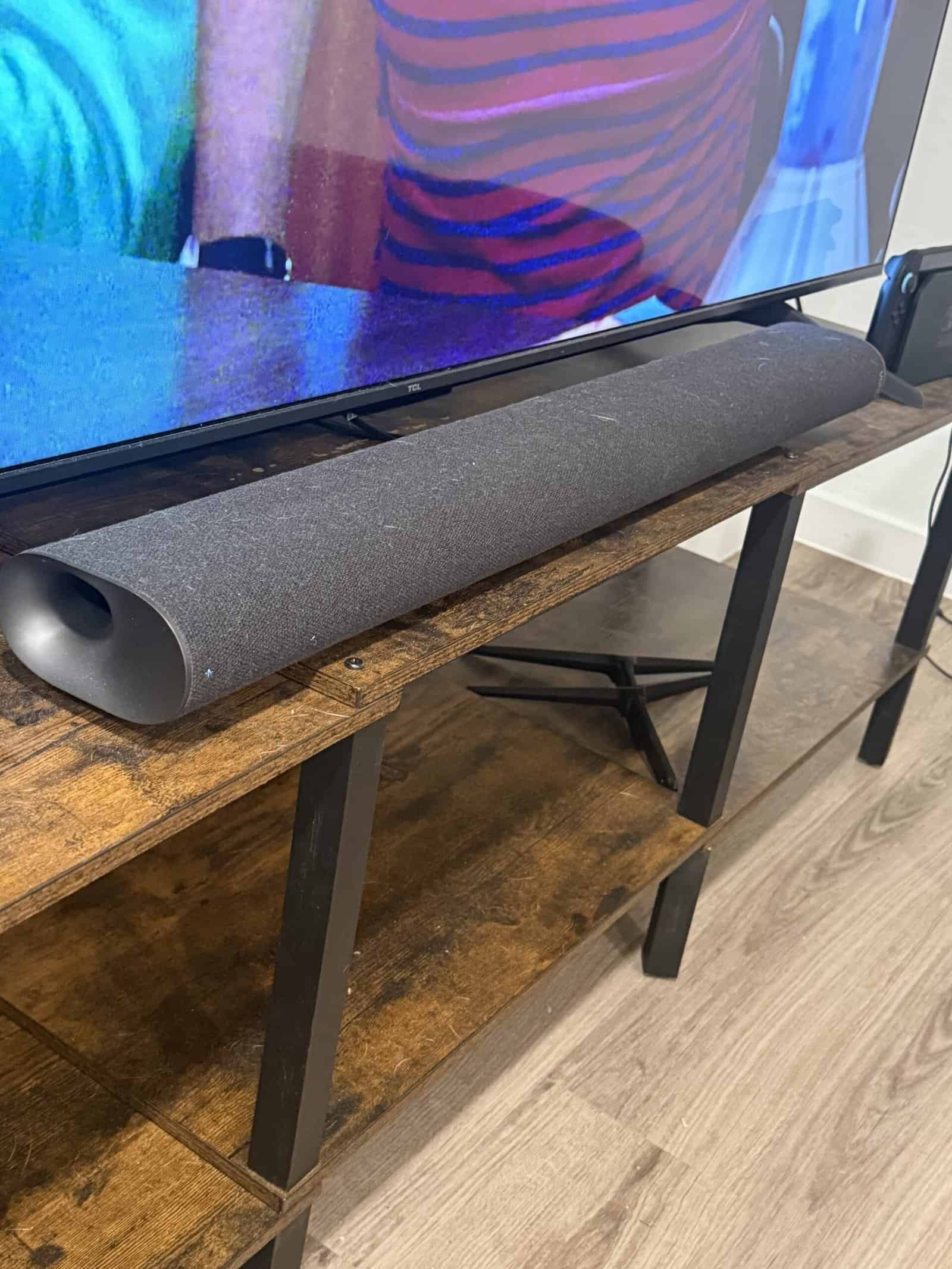
I have a Vizio all-in-one soundbar sitting on my TV stand, connected over HDMI ARC, and it has been there around two years. There is no separate subwoofer.
Dialogue clarity is genuinely good. Speech is clear and easy to follow, and it is a substantial improvement over the TV’s own speakers, which is what most people are actually comparing against.
What it does badly is the second problem. Music and score get much louder than dialogue during different parts of a film, which means adjusting the volume through a single viewing. That is the one complaint I have about an otherwise good piece of equipment.
Those two things sitting together in the same bar is the reason this article separates them. A bar can reproduce speech clearly and still leave you fighting the dynamic range, and someone buying purely for clarity may not solve the problem they actually have.
What I cannot compare is a bar with a separate subwoofer, a three-channel design, or an HDMI ARC connection, since mine is none of those. Those sections come from research rather than from my stand.
Why Modern Mixes Are Harder Work
Film audio is mixed for cinemas, where a large room and a calibrated system handle a wide gap between the quietest whisper and the loudest explosion. That gap is called dynamic range, and it is deliberate.
A living room does not have those conditions. Ambient noise sets a floor beneath which dialogue disappears, and neighbors or sleeping households set a ceiling above which you will not turn the volume. The mix was made for a range wider than the one you actually have.
Streaming compounds it, since a stereo downmix of a surround track folds the center channel in with everything else rather than keeping speech separate. That is why the same film can be clearer on one service than another.
None of that is your equipment failing. It is a mismatch between how the content was made and where you are watching it, which is exactly what night mode exists to bridge. Our roundup of speakers with physical buttons covers adjusting quickly.
Settings Before Spending
Check what your current bar already offers before replacing it. Night mode, dynamic range compression, and dialogue or voice enhancement are common and frequently switched off by default.
Look at the TV’s audio output setting too. A TV set to output a surround format that the bar downmixes can produce worse dialogue than setting the TV to stereo.
Streaming apps sometimes have their own audio settings, and choosing a stereo track over a surround one often improves speech intelligibility on a bar without discrete surround speakers.
Our note on soundbar apps and remotes covers finding these settings.
What to Look For
Which problem you actually have
Muddy speech and disappearing speech need different features. Diagnosing this first prevents buying the wrong solution.
A dedicated center channel
For clarity specifically, this is the structural feature that matters most.
Dynamic range controls
Night mode or volume leveling, and check they exist rather than assuming. Not every bar has them.
Connection type
HDMI ARC carries a fuller signal than Bluetooth and requires a cable and a compatible port.
Common Mistakes to Avoid
Buying for clarity when the issue is volume swings
A bar with excellent speech reproduction can still have music overwhelming dialogue. These are separate problems.
Turning the subwoofer up
More bass masks mid frequencies, which makes speech harder to follow rather than easier.
Ignoring the settings you have
Night mode and dialogue enhancement are frequently off by default, and trying them costs nothing before buying anything.
Assuming more channels always helps
A poorly placed multi-channel setup can be worse for dialogue than a well-positioned simple bar. Our roundup of TV stands and media consoles covers placement.
Worth reading next: our note on TV wall mounts, our roundup of smart speakers, our guide to smart light switches, and a roundup of entryway lighting.
Soundbar Dialogue FAQ
Why is dialogue hard to hear on my soundbar?
Either speech itself is muddy, which points at drivers and processing, or speech is clear but keeps getting buried under music and effects, which is a dynamic range issue. The fixes are different.
Does a center channel help?
For clarity, considerably. A dedicated driver handling dialogue rather than sharing duty with everything else is the most direct structural improvement available, and three-channel bars are the entry point.
What does night mode actually do?
It compresses dynamic range, lifting quiet passages and reducing loud ones so the gap between dialogue and effects narrows. That is what stops you adjusting the volume repeatedly through a film.
Will a subwoofer improve dialogue?
Indirectly, by letting the bar’s drivers concentrate on mid frequencies where speech sits. An overly loud subwoofer does the opposite, since excess bass masks the mids.
Is HDMI better than Bluetooth for dialogue?
HDMI ARC carries a fuller signal without the compression Bluetooth applies, and it supports surround formats Bluetooth cannot. Whether you notice depends on the bar and the content.
Should I change my TV’s audio settings?
Worth trying before buying anything. A TV outputting a surround format that the bar has to downmix can produce worse dialogue than simply setting the TV to stereo output.
Do dialogue enhancement modes work?
They boost the frequency range where speech sits, which helps with muddiness. They can make voices sound thin or processed, so it is worth listening rather than leaving it on permanently.
Would headphones solve it?
For solo late-night viewing, more completely than any soundbar setting. Speech at low volume is clearer through headphones, and it obviously does not work when watching with other people.
