
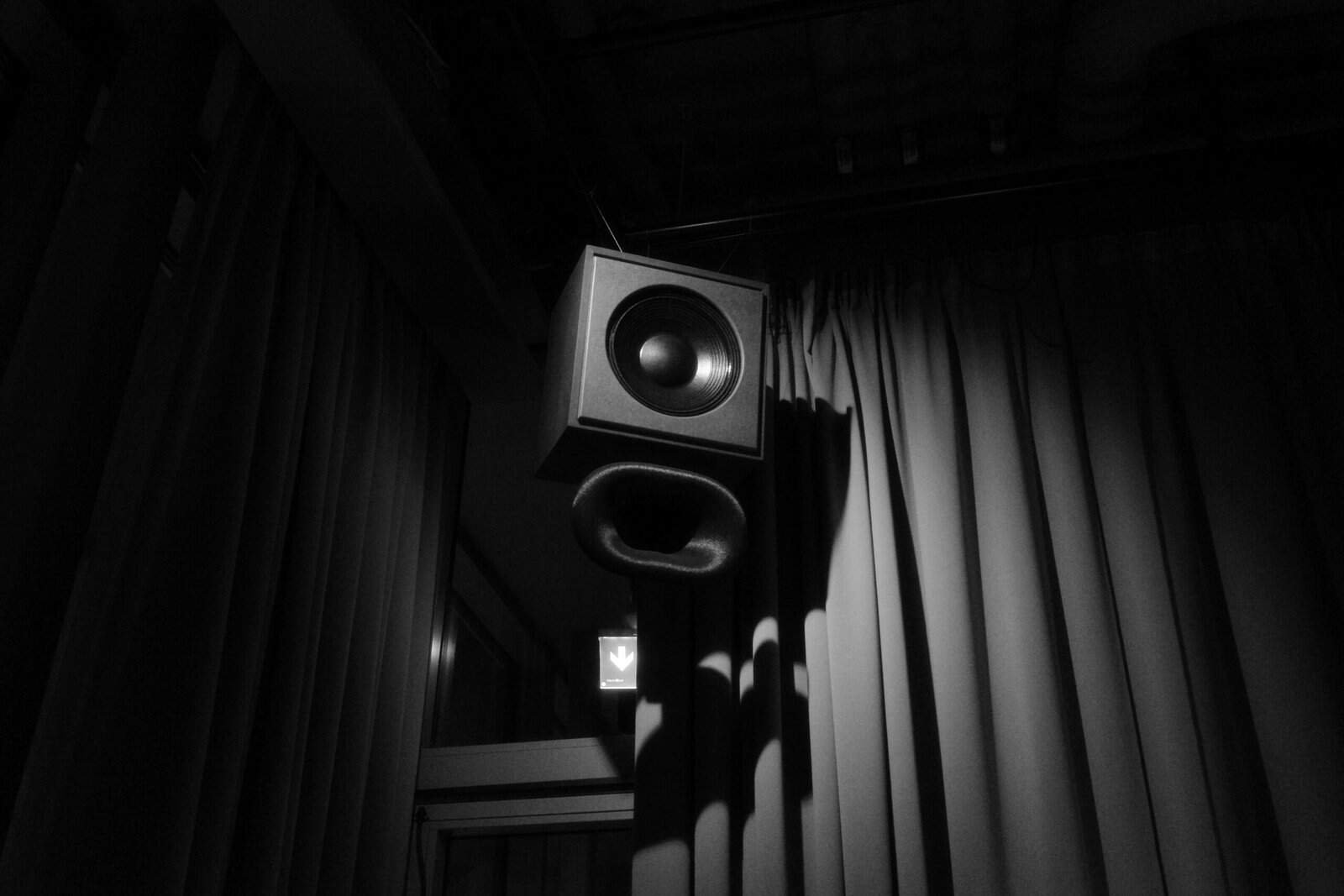
Start at the front of the room near your main speakers, then move it only if the bass sounds uneven. Where you should put a subwoofer depends far more on the shape of the room than on the subwoofer itself.
Bass behaves differently from everything else in audio, and that is the whole reason this question exists. Our guide to whether you need a subwoofer with a soundbar covers the step before this one.
Quick Answer
Front of the room blends best with your main speakers and hides the subwoofer’s location from your ear. A corner produces the most output and the busiest standing wave pattern. If the bass sounds thin from your seat, run the crawl and let the room pick the spot.
Key Takeaways
- Front of the room is the default and blends most smoothly.
- A corner gives you the most output you will get anywhere.
- Corners excite every room mode, which has upsides and downsides.
- Bass loudness varies hugely from seat to seat in the same room.
- A dead spot is called a null, and moving the sub or the seat fixes it.
- Two smaller subwoofers even out a room better than one large one.
- A soundbar’s wireless subwoofer belongs near the bar.
| Position | What it does well | The trade-off |
|---|---|---|
| Front of room, beside the speakers | Blends smoothly, sound stays anchored to the screen | May not be the flattest response |
| Front corner | Maximum output, excites every mode | Can sound boomy and uneven |
| Along a front wall, off center | Often a good compromise | Takes trial and error to find |
| Beside the seating | Strong bass at that one seat | Easy to localize, uneven elsewhere |
| Behind the seating | Sometimes flattest for one listener | Bass can feel detached from the picture |
| Inside a cabinet | Hides it | Resonance and rattle, restricted port |
| Two subwoofers, opposite positions | Smoothest response across more seats | Cost, and two boxes to place |
Why Bass Needs Its Own Rules
Low frequency waves are long, and in an ordinary room a single bass note can be longer than the room itself. That changes how it behaves.
Those long waves reflect off walls and combine with themselves. Where a wave meets its own reflection in step, bass gets louder. Where it meets out of step, bass cancels.
The result is a fixed map of loud and quiet spots across the room, called room modes. The map does not move, which means your seat sits somewhere on it whether you know that or not.
This is why bass placement is a room problem rather than a speaker problem. Our guide to choosing a soundbar covers the decisions that come before you get here.
What Corner Placement Actually Does
It maximizes output
Two walls and a floor meeting behind the box reinforce everything it produces. A corner is the loudest position available in any room.
It excites every mode in the room
Corner placement drives all the available room modes at once, which builds a denser pattern of standing waves. That reduces the chance of a dead spot without removing it.
The density cuts both ways
A busier pattern means fewer severe nulls, but it also means more peaks. That combination is what people describe as boomy or one-note bass.
It is a reasonable place to start
A corner is not wrong, and on a small or underpowered subwoofer the extra output is genuinely useful. It simply is not automatically the flattest answer.
Why the Front of the Room Wins by Default
Placing the subwoofer at the front, near the main speakers, is the most common arrangement and usually the best blend with them.
The other benefit is that your ear stops finding the box. When bass comes from roughly the same direction as everything else, the sound stays attached to the screen.
Bass off to one side or behind you breaks that illusion, and low notes start to feel like they belong to a separate device.
For a compact system in a modest room, front placement solves most of the problem before any measuring starts. Our roundup of soundbars for small rooms covers the systems this applies to most.
The Crawl, and Why It Beats Guessing
- Put the subwoofer where you sit. Set it on the seat or right beside it, at about head height.
- Loop a bass-heavy track. Something with a repeating low line rather than a single note.
- Move around the room on your knees. Listen at roughly knee level, which is close to where the driver will sit.
- Mark the spots that sound even. You are listening for accurate and balanced, not simply loudest.
- Reject the boomy positions. Anywhere the bass swells and dominates is a peak, not a win.
- Swap the subwoofer into the best spot. Put the box where your ears were and sit back down.
- Adjust level and crossover last. Placement first, settings second, never the other way around.
The method works because sound behaves the same in both directions. A spot that sounds even when your ear is there will sound even at your seat when the subwoofer is there instead.
Where a Soundbar Subwoofer Goes
A soundbar’s matched wireless subwoofer follows different advice, because it is designed as part of a pair rather than as a standalone box.
Keeping it in close proximity to the bar is the intended arrangement, and the usual spot is near the bar and the television, off to the left or right.
Wireless in this context means no audio cable to the bar. It still needs mains power, so the position has to reach an outlet.
Tucking one inside a closed cabinet is the common mistake. An enclosure adds resonance, rattles the doors, and can block a port the design depends on. Our guide to whether a soundbar sounds worse in a cabinet covers the same principle on the bar itself.
When One Subwoofer Is Not Enough
A single subwoofer can only ever be right for a small number of seats, because the room’s loud and quiet map does not care where the couch is.
Adding a second one greatly increases the modal density in the room. The practical result is a smoother response across more listening positions, with fewer obvious peaks and dead spots.
Two modest subwoofers usually beat one large one for evenness, which is the opposite of how most people shop.
Worth knowing before you plan for two: immersive audio formats generate a single low frequency effects signal, and whether your equipment offers more than one subwoofer output is a manufacturer decision. Our roundup of TV stands and media consoles covers the furniture side of finding room for the box.
A note on my own setup: I run an all-in-one bar with no separate subwoofer, so everything above is research rather than something from my own stand.
Related Reading
Frequently Asked Questions
Where should you put a subwoofer?
Start at the front of the room near your main speakers, since that blends best and keeps the sound anchored to the screen. If bass sounds thin or uneven from your seat, run the crawl to let the room choose. A corner gives maximum output but the least even response.
Is a corner a bad place for a subwoofer?
Not bad, just a trade. A corner reinforces output more than any other position and excites all the room’s modes, which builds a denser standing wave pattern and reduces the chance of a dead spot. The cost is more peaks, which is what boomy bass usually means.
What is the subwoofer crawl?
A method for letting the room pick the spot. Put the subwoofer at your listening position, loop a bass-heavy track, then move around the room at roughly knee level and note where the bass sounds most accurate and balanced. Swap the subwoofer into that spot afterward.
Why does bass sound different in different seats?
Because long bass waves reflect off walls and combine with themselves, creating a fixed pattern of loud spots and cancellations across the room. That pattern does not move. A seat sitting in a cancellation hears almost no bass while a seat a short distance away hears too much.
Can I hide a subwoofer in a cabinet?
It is the most common mistake. An enclosed space adds resonance, transmits vibration into the furniture, rattles doors, and can restrict a port the cabinet design relies on for output. If it has to be concealed, choose an open position with clearance rather than a closed compartment.
Are two subwoofers better than one?
For evenness across several seats, yes. A second subwoofer greatly increases modal density, which smooths the frequency response at more listening positions and reduces obvious peaks and nulls. Two modest units generally beat a single large one, though it means finding space and power for both.
Where does a soundbar’s wireless subwoofer go?
Near the bar. Matched subwoofers are designed to sit in close proximity to the soundbar, and the usual position is beside the bar and television on either side. Wireless refers to the audio link only, so it still needs to reach a mains outlet.
Does the subwoofer need to face the room?
Orientation matters less than position, because low frequencies are long enough that the direction the driver points has little effect. Give any port clearance from a wall or furniture, keep it off thick carpet where the design expects a hard floor, and prioritize finding a good position first.
