
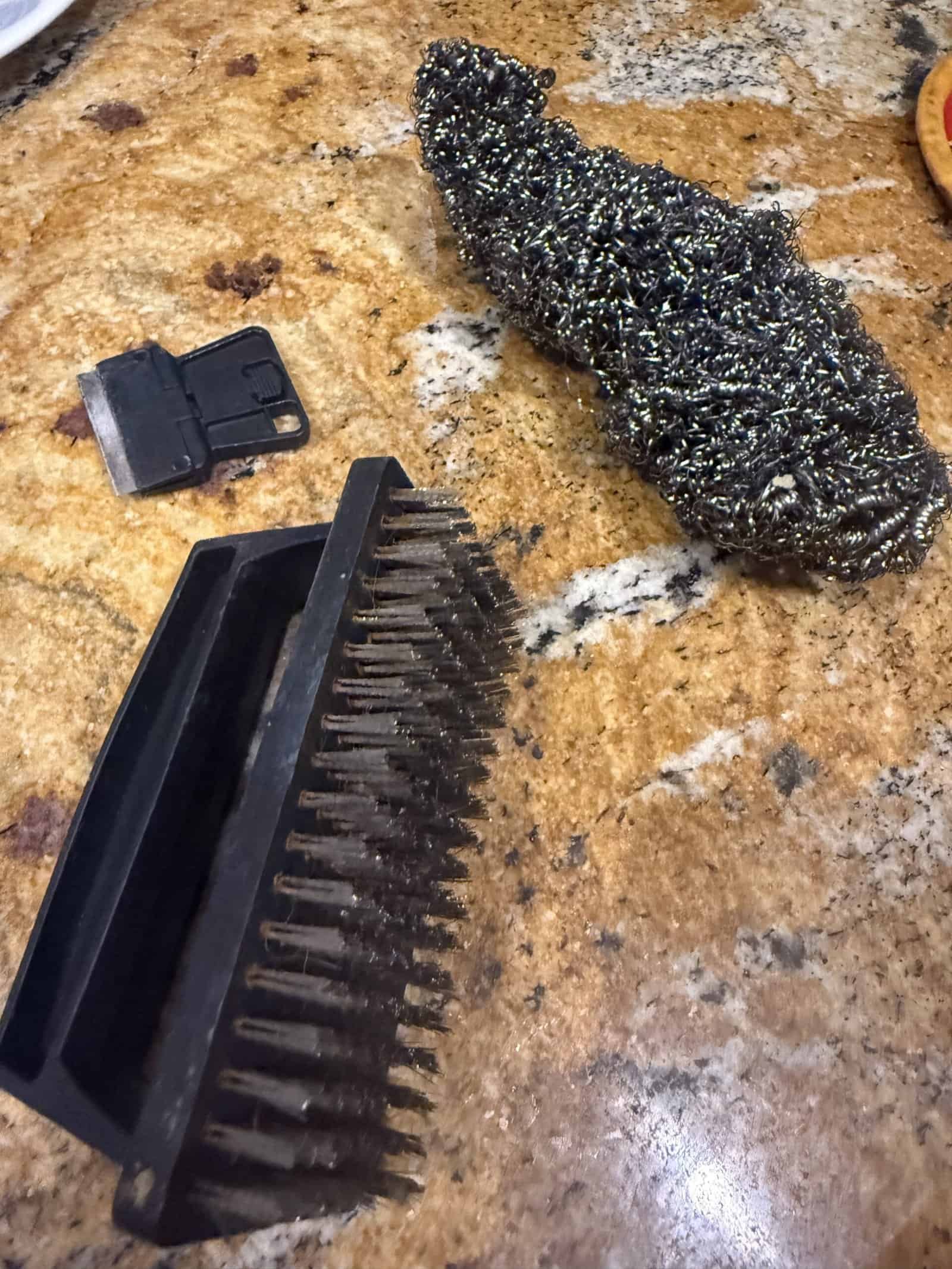
Cleaning cast iron is a problem of mechanical removal rather than chemistry. You need something abrasive enough to take off stuck food and gentle enough to leave the polymerized seasoning underneath, which is why the tools that work are scrubbers, scrapers, and stiff brushes rather than detergent and a sponge. Get the tool right and the whole routine takes about a minute. Our roundup of cast iron skillets covers the pans these look after.
Quick Verdict
A knitted stainless steel scrubber handles most cleaning and is the tool worth owning first. Add a pan scraper for anything genuinely stuck and a stiff brush if you prefer a handle between your hand and the pan. Chainmail is the better-known version of the same idea and not the only one.
Key Takeaways
- Mechanical removal beats detergent for seasoned cast iron.
- Knitted stainless and chainmail do the same job differently.
- Plastic scrapers get into corners that round tools miss.
- Wooden handles stay cooler when cleaning a warm pan.
- Drying matters more than which scrubber you chose.
How We Picked
Tools are grouped by how they remove residue, since scrubbing, scraping, and brushing solve different parts of the same job. Handle design is weighted alongside the working surface, because a tool that puts your knuckles near a warm pan gets used carefully rather than effectively.
Selections reflect construction and how each type behaves against seasoning. Descriptions come from product research except where personal use is stated directly.
1. A Knitted Stainless Steel Scrubber, Best Overall
Why It Stands Out
Knitted stainless is a loose mesh of fine steel that conforms to the pan surface, so it reaches the curve where the base meets the wall rather than bridging over it. It is abrasive enough to lift cooked-on residue and does not strip established seasoning in normal use.
It also rinses clean and dries fast, which matters for something that lives near a sink and never gets soap.
Worth Knowing
Knitted stainless and chainmail are frequently treated as the same product and they are not. Chainmail is interlocking rings, knitted stainless is woven mesh. Both work, and the mesh version is softer in the hand and cheaper.
Either will eventually catch and pull a thread. That is normal and does not affect the cleaning. Our guide to seasoning cast iron covers what you are protecting.
This suits almost everyone. Skip it only if you dislike handling metal mesh directly.
2. A Chainmail Scrubber, Best Known Option
Why It Stands Out
Interlocking stainless rings give a rigid scrubbing surface that is highly effective on baked-on residue, and the design has become the default recommendation for good reason.
Rings also do not snag the way a woven mesh eventually does, so a chainmail square tends to look the same after years.
Worth Knowing
Chainmail is stiffer, which makes it harder to press into the corner between base and wall. Some designs add a silicone backing to help with grip and that reduces flexibility further.
It costs more than knitted stainless for a similar result, and the choice between them is preference rather than performance. Our roundup of carbon steel pans covers another surface these suit.
This suits anyone wanting the durable version. Skip it if flexibility matters more than longevity.
3. A Polycarbonate Pan Scraper, Best for Stuck Food
Why It Stands Out
Hard plastic scrapers have straight edges, curved edges, and corners on a single piece, so one tool reaches the flat base, the wall curve, and the awkward junction where a handle meets the pan.
They also lift genuinely welded-on food that a scrubber will only polish, which makes them the right first move rather than a last resort.
Worth Knowing
Cheap scrapers can develop a rough edge that scratches, so check them occasionally and replace when the edge stops being clean.
They are worth buying in pairs, since these are exactly the kind of small tool that migrates into a drawer and disappears. Our roundup of kitchen drawer organizers covers keeping small tools findable.
This suits stuck-on residue and awkward corners. Skip it if food never sticks.
4. A Stiff-Bristle Brush With a Wooden Handle, Best for Hot Pans
Why It Stands Out
A long-handled brush lets you clean a pan while it is still warm, which is when residue comes off most easily, without putting your hand near the metal.
Wooden handles stay cool and do not soften near heat the way some plastics can.
Worth Knowing
Bristles are gentler than steel, so a brush handles routine cleaning well and struggles with anything genuinely baked on. It pairs with a scraper rather than replacing one.
Natural bristle brushes need drying between uses or the base can develop a smell. Standing it bristles-up solves that.
This suits cleaning warm pans and anyone who prefers a handle. Skip it as your only tool.
5. Coarse Salt as an Abrasive, Best Non-Tool
Why It Stands Out
Coarse salt with a little oil and a paper towel or cloth is an effective scouring method that costs nothing and is already in the kitchen.
It also works on a pan you want to clean without wetting, which suits a quick reset between two dishes.
Worth Knowing
This is more effort than a scrubber for the same outcome, and it uses a surprising amount of salt on a large skillet.
Salt left in the pan will draw moisture and can cause spotting, so rinse and dry properly afterward rather than tipping it out and walking away.
This suits an occasional deep clean. Skip it as a daily routine.
6. Silicone Handle Covers, Best Supporting Tool
Why It Stands Out
A sleeve on the main handle and a small grip on the helper handle let you move and hold a hot pan while cleaning it, which is the moment residue lifts most easily.
They also stay on the pan between uses rather than being something to find.
Worth Knowing
Silicone has a temperature limit, so covers should come off before a pan goes into a hot oven. Check the stated rating rather than assuming.
They also trap moisture underneath if left on a wet handle, which is worth removing occasionally to check. Our roundup of silicone handle covers covers the options in detail.
This suits anyone cleaning pans warm. Skip it if you always let the pan cool fully.
Cleaning Tools at a Glance
| Tool | Best at | Handle | Buy first? |
|---|---|---|---|
| Knitted stainless scrubber | General cleaning | None, in hand | Yes |
| Chainmail | Baked-on residue | Sometimes silicone | Alternative to above |
| Pan scraper | Stuck food, corners | Held directly | Yes, second |
| Stiff brush | Warm pans, routine | Long, wooden | Optional |
| Coarse salt | Occasional scour | Cloth or towel | Already own it |
| Silicone covers | Handling while warm | Stays on pan | Optional |
What I Use and How
I have had my cast iron skillet for over three years and the seasoning has held. The tools I own for it are a knitted stainless steel scrubber, a wire brush with a wooden handle, two pan scrapers, and silicone handle covers, which is a long sleeve on the main handle and a small grip on the helper handle.
The scrubber is what I actually reach for. The brush and the scrapers get used when something is properly stuck, and most of the time the mesh handles it on its own.
The routine is no soap, then towel dry, then a thin coat of canola oil. Worth being honest about one part of that: the standard advice is to dry cast iron on a burner so any remaining moisture evaporates. I do not do that. I towel it and leave it, and over three years that has not caused a problem for me.
That is one pan in one kitchen rather than a general rule, and a pan left genuinely wet will rust regardless of what anyone says. If you skip the heat-drying step, the towel needs to do a proper job. The oil afterward matters too, and canola is what I use because it is what is already in the cupboard.
What to Look For in Cast Iron Tools
Does it reach the corner?
The junction between base and wall is where residue collects. Flexible mesh and shaped scrapers get in there; rigid flat tools bridge over it.
Will it strip the seasoning?
Stainless mesh and plastic scrapers will not, in normal use. Steel wool and abrasive powders will, which is why they belong in a stripping-and-reseasoning job rather than a weekly one.
Can you use it on a warm pan?
Residue lifts most easily before the pan cools. Tools with handles, or a pan with silicone covers, let you take advantage of that safely.
Does it dry quickly?
Anything that stays damp near a cast iron pan is working against you. Metal mesh and plastic scrapers dry fast; natural bristle brushes need standing up to drain.
Scrubber or Scraper?
Start with the scrubber
It handles the majority of cleaning on its own, needs no technique, and works across the whole pan surface. If you own one tool, this is the one.
Add the scraper
For anything genuinely welded on, a scraper removes in seconds what a scrubber will spend a minute polishing. They complement rather than compete, and a scraper costs very little. Our guide to cleaning a cast iron skillet covers the order to use them in.
Common Cast Iron Cleaning Mistakes to Avoid
Reaching for steel wool
Steel wool and abrasive powders strip seasoning rather than cleaning through it. Stainless mesh is the tool that removes food and leaves the surface.
Letting the pan soak
Standing water is what rusts cast iron. Clean it soon after cooking, and never leave it sitting in the sink overnight.
Skipping the oil
A thin coat after drying maintains the surface between cooks. It takes seconds and it is the step people drop first.
Using too much oil
A heavy coat goes sticky and attracts dust rather than protecting anything. Thin enough that the pan looks barely oiled is correct. Our roundup of cast iron accessories covers what to use.
Recommended Reading
See our roundup of Dutch ovens, our note on grill pans, our pizza pan picks, and a guide to organizing a kitchen, and choosing the right cookware.
Cast Iron Cleaning FAQ
What is the difference between chainmail and knitted stainless?
Chainmail is interlocking rings and knitted stainless is a woven mesh of fine steel. Both clean effectively without stripping seasoning. Chainmail is more durable and stiffer; knitted mesh is more flexible into the corner between base and wall, and usually cheaper.
Can I use soap on cast iron?
Modern dish soap will not destroy established seasoning the way older lye-based soaps could, and most people cleaning mechanically find they simply do not need it. The traditional no-soap approach works because a scrubber removes residue without any.
Do I have to dry cast iron on the stove?
It is the standard advice, because heat drives off moisture a towel might miss. Plenty of people towel dry and oil instead without problems, provided the towel does a thorough job. What matters is that the pan is genuinely dry before it goes away.
What oil should I use after cleaning?
Any neutral cooking oil in a very thin coat. Canola, vegetable, and grapeseed all work. The amount matters more than the type, since a heavy coat goes sticky rather than protecting the surface.
Will a scrubber remove my seasoning?
Not in normal use. Stainless mesh removes food residue while leaving the polymerized layer bonded to the metal underneath. Steel wool and abrasive cleaning powders are a different matter and will strip it.
How do I clean a pan with badly stuck food?
Start with a scraper rather than scrubbing, since it lifts welded-on residue in seconds. If that is not enough, simmering a little water in the pan for a few minutes loosens things, then scrape and dry thoroughly.
Can I put cast iron in the dishwasher?
No. Prolonged water exposure and dishwasher detergent will strip seasoning and cause rust. Cast iron is the one thing in the kitchen where hand cleaning is not a preference.
How often should I re-season?
Only when the surface tells you to, meaning food starts sticking or the finish looks patchy and dull. A pan cleaned mechanically and oiled after each use can go years without a full re-seasoning.
