
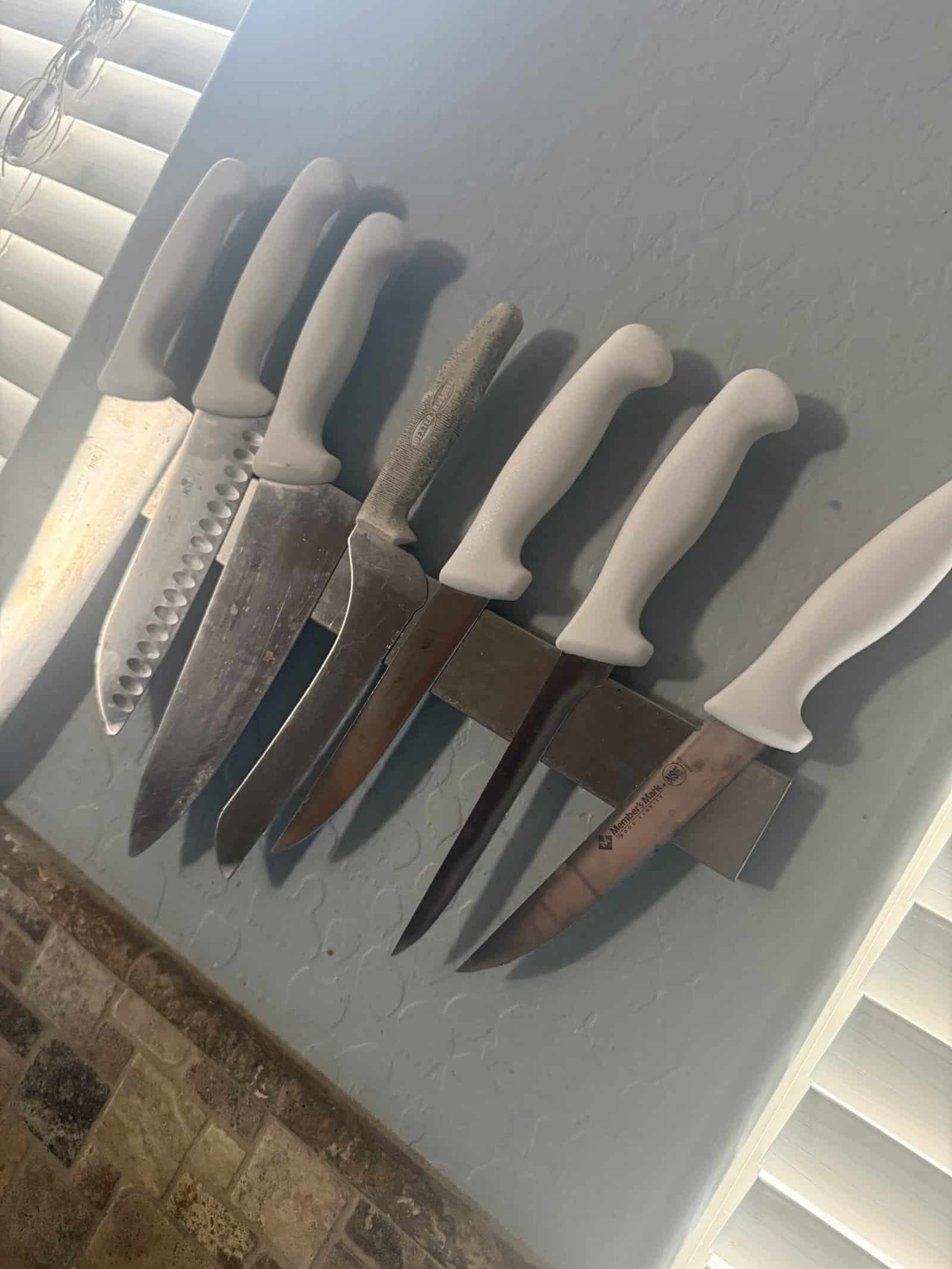
The magnet is not the problem here. The concern people usually raise is that a magnetic strip will either magnetize the blade or dull it over time, and neither of those happens in any way that matters for kitchen knives.
Mine is a bare steel strip that has been up on the wall for one to two years now, holding chef knives the whole time, and there has been no change in any of them that I can detect. Our roundup of magnetic knife strips covers the hardware.
Quick Answer
Magnets do not dull or ruin knives. Damage comes from how the blade contacts the strip, not from magnetism. Place edge-up and lift straight off rather than dragging.
What Actually Causes Wear
| Cause | Real risk |
|---|---|
| Magnetism itself | Essentially none |
| Dragging the edge across the bar | Real, and avoidable |
| Slapping the blade on flat | Chipping on thin or brittle edges |
| Blades knocking each other | Real if spaced too close |
| Bare steel against the edge | Harder than a wood facing |
| A strip too weak for the knife | Falling blades, the worst outcome |
The Magnetization Question
A knife left sitting on a magnetic strip can pick up a slight residual magnetism over time, which is a real effect and almost entirely inconsequential in a kitchen.
The practical effect of that is a blade which might pick up a paperclip. It does nothing to the edge, nothing to the steel, and nothing to how the knife cuts.
Mine have been on a strip for one to two years with no change I have noticed in how they perform.
Where residual magnetization genuinely matters is in precision tooling and in electronics work, neither of which is happening in a kitchen. Our note on magnetic strip versus knife block covers the comparison.
Contact Is the Real Issue
Place the spine first
Let the back of the blade touch the strip before the edge nears it.
Lift straight off
Pulling sideways drags the edge across the bar.
Do not let it snap on
A strong magnet pulls the blade in, and the last inch is where chipping happens.
Space the knives out
Blades that swing into each other do more damage than the strip.
Bare Steel Versus Wood Faced
Bare stainless strips place the magnet directly behind a metal face, and that arrangement gives you both the strongest hold available and the hardest possible contact surface for an edge.
Wood-faced strips put a softer layer in between the magnet and the blade itself, which is noticeably gentler on edges while being slightly weaker in overall hold.
Mine is a bare steel one and the knives living on it are chef knives, which carry enough blade mass that the harder contact surface has never been an issue.
For thin or delicate blades a wood face is the more forgiving choice, and it is the one difference between strip types that genuinely affects knives. Our roundup of chef knives covers blade construction.
What Goes on a Strip and What Does Not
Chef knives, bread knives, and larger blades generally suit a magnetic strip very well, since they have the mass to sit stably against it and the magnet has plenty of steel to grip onto.
Mine holds chef knives and nothing else. The steak knives around here are the small ones with plastic handles on them, and those live somewhere else entirely rather than up on the strip.
Plastic and composite handles tend to appear on knives with rather less blade steel behind them, and less steel means a weaker hold from exactly the same magnet.
Anything with a partial tang or an unusually light blade is worth checking carefully before you trust it to stay up there on its own. Our roundup of steak knives covers those.
Cleaning and Rust on the Strip
A strip in a kitchen collects the same airborne grease everything else does, and that matters more here than on decorative hardware.
Grease on the face reduces the effective hold, because the blade is no longer sitting flush against the magnet surface.
It also transfers to the blade, which means a knife pulled off a dirty strip goes straight to food carrying whatever was on the bar.
Wiping the face down when you clean the counter handles it entirely, and bare steel wipes cleaner than a wood facing does.
Knives going onto a strip should be fully dry as well, since trapped moisture between blade and bar is where spotting starts on carbon steel and on the cheaper stainless grades. Our note on cleaning cast iron covers the same moisture principle.
The Failure Mode That Matters
A knife falling off a strip is the genuine risk, and it is worse than anything magnetism could do.
Undersized strips, weak magnets, and mounting into drywall without proper anchors behind it all cause exactly that, and the consequence is a sharp blade landing point-down on a hard floor.
Strips should be rated for considerably more weight than you actually intend to hang on them, and the mounting needs to go into studs or use anchors rated for the load.
That is a hardware question rather than a knife question, and it is the one worth spending attention on. Our note on storing knives safely covers the alternatives.
Why Blocks Are Not Automatically Gentler
Knife blocks get recommended as the safe option, and the slots drag the edge along wood every time a knife goes in or comes out.
Knife blocks also trap moisture down inside the slots, which becomes both a rust problem and a hygiene one that an open strip simply does not have.
An in-drawer organizer avoids both of those problems at once, at the cost of drawer space, which is frequently the tightest constraint in the whole kitchen.
None of the three storage methods is dramatically harder on knives than the others when used correctly. Our note on when to replace kitchen knives covers actual wear.
What Actually Dulls a Knife
The cutting board itself
Glass and stone boards dull an edge faster than any storage method.
The dishwasher
Blades knocking against other items during a cycle.
Scraping with the edge
Using the blade to sweep food off a board rather than the spine.
Normal everyday use
Edges dull from cutting, which is why sharpening exists.
Common Mistakes to Avoid
Letting the blade snap onto the strip
The magnet pulls hard at the last inch, and that impact is what chips edges.
Pulling knives off sideways
That drags the edge along the bar. Lift straight out instead.
Undersized or badly mounted strips
A falling knife is the only outcome here that genuinely matters.
Crowding blades together
Knives that swing into each other cause more damage than the strip ever will.
Recommended Reading
See our roundup of knife sharpeners, our note on whether electric sharpeners are good, our roundup of cutting boards, and a roundup of cabinet and shelf organizers.
Magnetic Knife Strip FAQ
Do magnetic strips damage knives?
Not through magnetism. Damage comes from how the blade contacts the bar, which means dragging the edge or letting it snap on hard.
Do they magnetize the blade?
Slightly, and it does not matter. The blade might attract a paperclip. It has no effect on the edge or on cutting.
What do you use?
A bare steel strip, up for one to two years, holding chef knives. No change in them that I can detect.
Bare steel or wood faced?
Wood is gentler on edges and holds slightly less strongly. Bare steel holds harder and is a harder contact surface. Wood suits thin or delicate blades.
How should I put a knife on?
Spine first, so the back of the blade touches before the edge nears the bar. Lift straight off rather than pulling sideways.
Can all knives go on a strip?
Larger blades work best. Light knives with less steel and plastic handles hold more weakly, so test before trusting them to stay up.
Is a knife block safer?
Not automatically. Slots drag the edge along wood every time, and blocks trap moisture, which a strip does not.
What actually dulls knives?
Cutting boards, particularly glass and stone. Dishwashers. Scraping with the edge rather than the spine. And ordinary use, which is what sharpening is for.
