
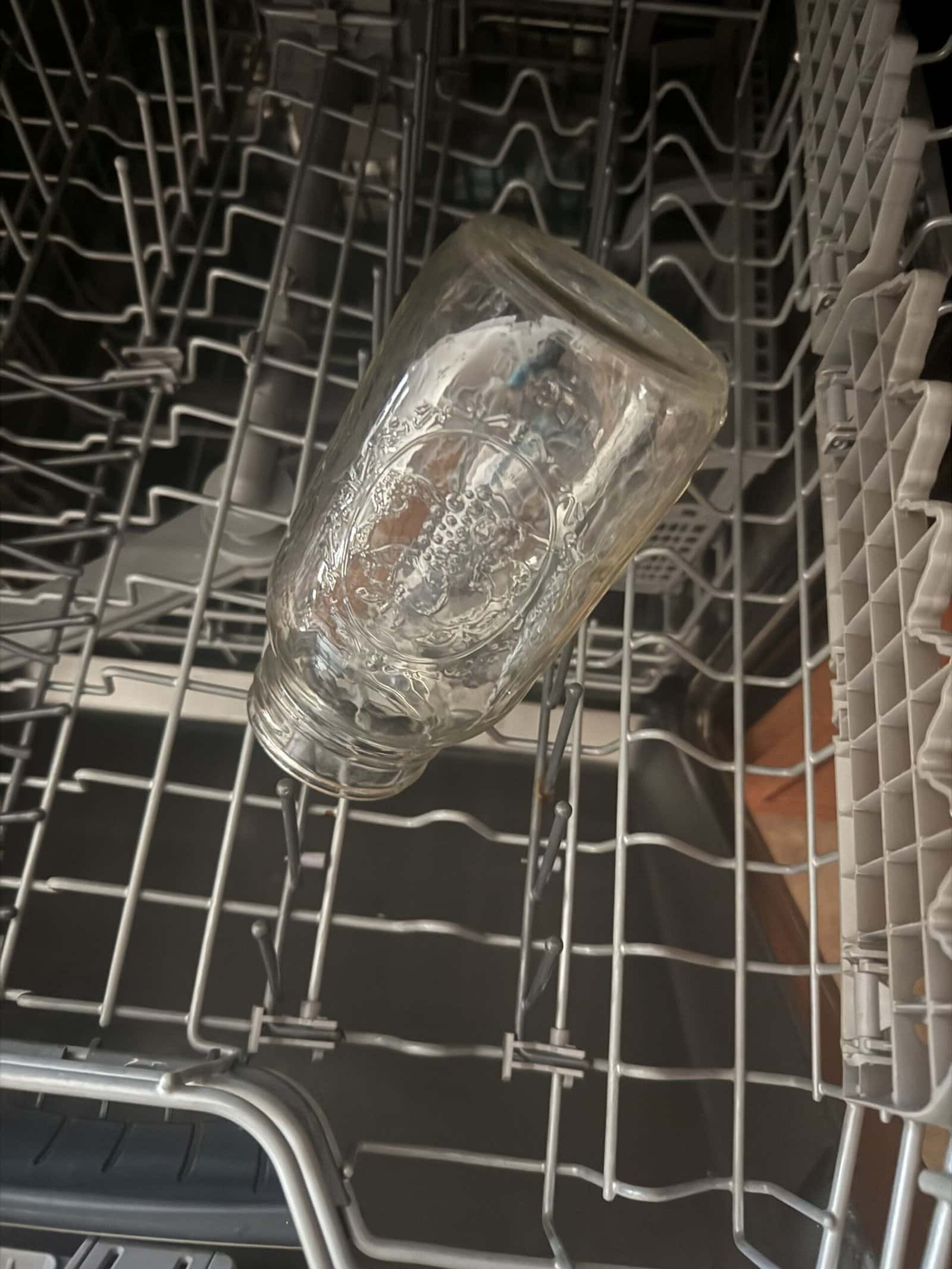
The jars themselves are fine. Mason jars are tempered soda-lime glass and manufacturers generally list them as dishwasher safe, which is why they turn up in dishwashers constantly without incident.
Mine go in the dishwasher and not one of them has cracked yet. They also do not go through the machine all that often, because they are mostly holding something in long-term storage or getting used for drinking water rather than cycling through meals daily. Our roundup of mason jars covers the jars themselves.
Quick Answer
Jars yes, on any rack. Two-piece metal lids are where the trouble is, since bands and flats can rust or lose their seal. Wash those by hand if you intend to can with them.
Component by Component
| Part | Dishwasher | Why |
|---|---|---|
| The jar | Yes | Tempered glass, generally rated safe |
| Metal band (ring) | Risky | Can rust, particularly at the crimped edge |
| Flat lid with sealing compound | No | Heat can affect the seal |
| Plastic storage lids | Top rack only | Warps on the bottom rack |
| Silicone gaskets | Yes | Remove from the lid first |
| Decorative or painted jars | No | Finish comes off |
Why the Glass Handles It
Mason jars are built to be filled with boiling contents and then processed in a rolling water bath, which makes a dishwasher cycle a comparatively mild environment for them.
What actually breaks canning jars is thermal shock, meaning a rapid swing in temperature rather than heat on its own, and a dishwasher both heats and cools gradually enough to avoid it.
Mine have been through without any cracking, and that is the common experience rather than a lucky one.
The one real exception is a jar that already carries a chip or a hairline flaw somewhere, since existing damage is always where a crack starts from. Our note on what to use mason jars for covers the applications.
The Lids Are the Real Question
Bands rust at the crimp
The rolled edge holds water, and repeated cycles work on it.
Flats are single-use for canning anyway
Manufacturers do not recommend reusing the sealing compound.
Storage lids are different
Plastic ones are fine on the top rack and warp on the bottom.
Hand washing takes seconds
Which is why most people separate the lids out.
Storage Jars Do Not Get Washed Much
A jar sitting there holding dry goods for months on end does not need washing between refills the way a dinner plate does after every single meal.
That changes the whole calculation considerably, because the dishwasher question matters a great deal less for jars that only go through it a handful of times in a year.
Mine are mostly holding storage or drinking water, so they cycle through the machine rarely, which is very probably part of the reason nothing has failed on them yet.
Jars being used for daily food storage or weekly meal prep get washed far more often than that, and heavy use is exactly where lid wear starts showing up first. Our roundup of food storage containers covers the alternatives.
Loading Them Properly
Jars go in upside down so that water drains out rather than pooling in the base, and loading them the wrong way up is far and away the most common reason a jar comes out with standing water sitting in it.
Tall quart jars frequently will not clear the top rack at all, and forcing one in against a spray arm stops that arm turning, which leaves the entire load dirty rather than just the jar.
Wide mouth jars come out cleaner than regular mouth ones do, simply because the spray reaches the interior surfaces far more directly.
Spacing matters as well. Jars packed in tightly end up shielding each other from the spray entirely, and those come out with residue still inside them. Our note on why a dishwasher leaves spots covers water contact.
Regular Mouth or Wide Mouth
The two standard openings behave differently in a dishwasher, and it is the sort of thing nobody considers until a jar comes out with residue in it.
Wide mouth jars let spray reach the interior walls and the base directly, which is why they come out reliably clean without any pre-rinsing.
Regular mouth jars have a shoulder that narrows toward the top, and that shoulder shields part of the interior from direct spray.
Anything sticky or dried on tends to survive in a regular mouth jar where it would have been blasted off a wide mouth one, so a quick rinse before loading is worth doing for those.
The shoulder also makes regular mouth jars unsuitable for freezing, since liquid expanding upward gets trapped under the narrower neck and cracks the glass at the shoulder. Our roundup of meal prep containers covers the two shapes.
Hard Water and Cloudiness
Glass that comes out looking cloudy is usually carrying mineral deposit from hard water rather than any actual damage to the glass itself.
That wipes off with vinegar and generally does not affect the jar’s function, though it builds up over repeated cycles.
Etching is the permanent version of the same appearance, caused by soft water combined with too much detergent, and it looks broadly similar while never coming off at all.
Telling them apart is simple. If vinegar clears it, it was deposit. If not, the surface is etched.
Canning Changes the Rules
Jars intended for canning need to be hot when filled, and running them through a dishwasher cycle is one accepted way to achieve that.
The sealing surface on the jar rim matters enormously for canning, so any chip or nick there rules the jar out regardless of how it was washed.
Flat lids should not go through a dishwasher if you plan to seal with them, since the compound needs to be in known condition.
For storage and drinking use, none of that applies and the jars are simply glass containers. Our roundup of pantry storage containers covers dry goods.
What to Avoid
Jars with existing chips
Damage is where a crack propagates from, in a dishwasher or anywhere else.
Painted or decorated jars
The finish comes off, sometimes onto everything else in the load.
Vintage or unmarked jars
Older glass was not made to modern tempering standards.
Forcing tall jars under a spray arm
A blocked arm means the entire load comes out dirty.
Common Mistakes to Avoid
Running two-piece canning lids through
Bands rust at the crimped edge and flats have sealing compound that should stay in known condition.
Loading jars upright
Water pools in the base and the interior never gets properly cleaned.
Assuming cloudiness is damage
Usually hard water deposit, which vinegar removes.
Plastic storage lids on the bottom rack
They warp, and a warped lid stops sealing.
Recommended Reading
See our roundup of drinking glasses, our note on organizing your kitchen, our roundup of cabinet organizers, and a roundup of coffee storage canisters.
Mason Jar Dishwasher FAQ
Are mason jars dishwasher safe?
The jars yes. They are tempered glass built to handle boiling contents and water bath processing, so a dishwasher cycle is comparatively mild.
Do yours go in?
Yes, and none has cracked. They do not go through often though, since they are mostly holding storage or being used for water rather than cycling daily.
What about the lids?
Two-piece canning lids are the weak point. Bands rust at the crimped edge, and flats have sealing compound that should stay in known condition. Hand wash those.
Why did my jar come out with water inside?
Loaded upright. Jars go upside down so water drains rather than pooling in the base.
Is cloudy glass ruined?
Usually not. Hard water deposit wipes off with vinegar. If vinegar does not clear it, the surface is etched and that is permanent.
Can I put plastic storage lids in?
Top rack only. The bottom rack runs hotter and warps them, and a warped lid stops sealing properly.
What about older jars?
Vintage and unmarked glass was not made to modern tempering standards, so hand washing is the safer approach with anything you cannot identify.
Does it matter for canning?
Yes. Jars need to be hot when filled and the rim has to be free of chips. Flat lids should not go through if you intend to seal with them.
