
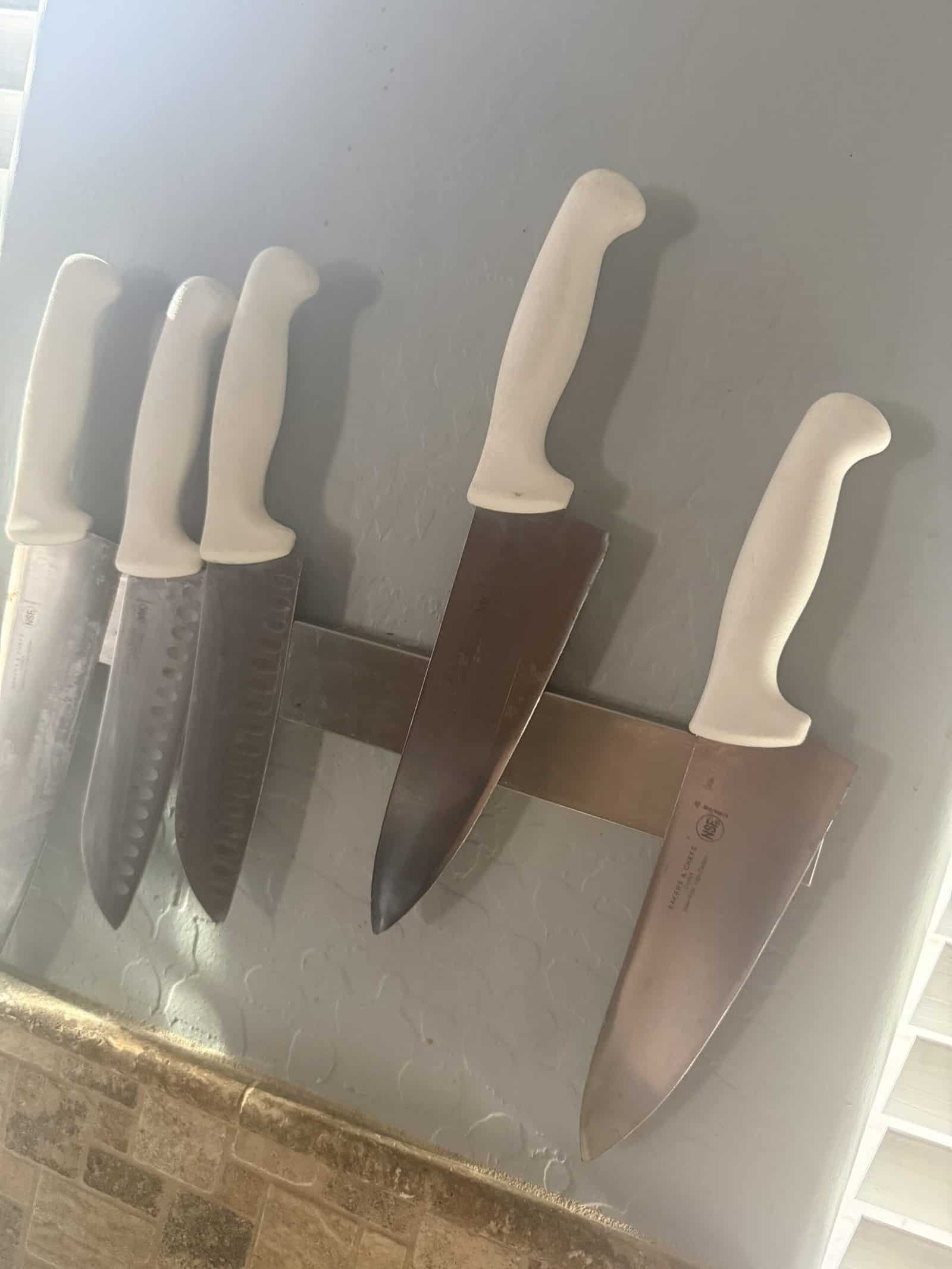
You are not supposed to, and I do it anyway. I rinse mine and put them in, and I know that is not the recommendation. So rather than pretend otherwise, here is what actually happens when knives go through a dishwasher, which knives survive it, and where the real line is.
Quick Verdict
The dishwasher will dull and damage a good knife faster than hand washing. It will not destroy a sturdy serrated steak knife on any timescale you will notice. Keep your chef’s knife out. The rest is a judgment call about how much you care.
Key Takeaways
- Heat, detergent, and knocking about are the three problems, in that order.
- Wooden handles genuinely suffer. That one is not debatable.
- Serrated steak knives tolerate it far better than a fine straight edge.
- Rinsing first removes the worst of the acid and salt.
- Your chef’s knife is the one to protect. It is doing the real work.
What the Dishwasher Actually Does
| Problem | What it causes | How much it matters |
|---|---|---|
| Detergent | Pitting, dulling, corrosion over time | Real, and cumulative |
| Heat | Handle damage, adhesive failure | Real on wood, minor on plastic |
| Knocking | Nicked, rolled edges | The fastest damage |
| Long wet cycle | Corrosion on carbon steel | Severe on carbon, minor on stainless |
| Safety | Blade up in a basket, unseen | The one nobody mentions |
The Three Things That Do the Damage
Dishwasher detergent is aggressive. It is designed to strip baked-on grease, and it is far harsher than dish soap. On a blade that means slow pitting and corrosion, which is worse on carbon steel than stainless but is not zero on either.
Heat is mostly a handle problem. A drying cycle runs hot for a long time, and wooden handles do not enjoy that. They dry, shrink, and eventually loosen or crack where they meet the tang. This is the one where the conventional advice is simply correct and there is no arguing.
Knocking around is the quiet one and probably the biggest. A knife in a basket moves during the cycle, and every contact with another utensil rolls or nicks the edge. It is the same reason a knife drawer dulls knives, just wetter. Most dulling comes from contact rather than cutting, and a dishwasher is a machine for making things touch each other.
What I Do, and What It Actually Costs
I rinse them, then they go in. That is the truth of it.
The rinse matters more than it sounds. Getting acid, salt, and food residue off before the knife sits in a warm wet box for ninety minutes removes the worst of the corrosion risk. A knife that goes in dirty sits in that mess the whole cycle.
Here is the part that complicates the standard advice: I do not notice them dulling much. I sharpen once in a while, not because the knives are demanding it but because it seems like the thing to do. If the dishwasher were quietly wrecking my edges I would expect to have noticed by now, and I have not.
I do not think that makes the advice wrong. I think it means my particular setup is forgiving, and it is worth understanding why, because yours might not be.
Why I Get Away With It
Four things, and they stack.
My knives are stainless, which shrugs off detergent that would pit carbon steel. The handles are plastic, so there is no wood to dry out, loosen, or crack. The ones I use most are serrated steak knives, which have almost no fine bevel to lose. And I cut on a big wooden board, which is kind to edges in a way glass or stone never is.
Change any one of those and the maths shifts. A carbon steel blade with a wooden handle, straight-edged, used on a glass board, would be a genuine casualty. The dishwasher is not doing nothing to my knives, it is doing something small to knives that were built to tolerate small things.
So when people say the dishwasher ruins knives, they are not lying. They are describing what it does to good knives. It does considerably less to a sturdy stainless serrated steak knife with a molded handle, which happens to describe most of what is in my kitchen.
The Knives That Actually Tolerate It
Not all knives lose equally, and this is where the blanket advice gets unhelpful.
Serrated steak knives are the survivors. A serrated edge does its cutting with points and scallops rather than a fine polished bevel, so there is much less to lose. A rolled micro-edge on a straight blade is a real problem; on a serrated one it is close to irrelevant.
Which is why the knives I reach for most are the ridged steak knives, and why running them through the dishwasher has never bothered me. They are stainless, sturdy, serrated, plastic-handled, and largely indifferent to the whole thing.
Cheap stainless paring knives are much the same. If it cost eight dollars and has a molded handle, the dishwasher is not the thing that will end it. Paring knives are the definition of a knife not worth agonising over.
The Knives to Keep Out
The line, if you want one, is: anything with a wooden handle, anything carbon steel, and your chef’s knife.
Wooden handles are the clearest case. Heat and long wet cycles loosen and crack them, and that damage does not sharpen out.
Carbon steel is the other clear one. It corrodes readily in ordinary use and a dishwasher is close to a worst case. The steel comparison gets into why, but if you own carbon steel you already know it needs drying immediately.
And the chef’s knife, because it does most of the work and it is the one where a fine edge actually pays you back. Hand washing one knife takes fifteen seconds. That is a reasonable price for keeping the one that matters sharp.
The Safety Part Nobody Mentions
Blades in a dishwasher basket point somewhere, and often it is up.
Reaching into a basket you are not looking at, with a knife edge-up in it, is a genuinely bad arrangement. If knives are going in, lay them flat on the top rack or put them in the basket handle-up. The edge should be somewhere your hand is not.
This is the one part of dishwasher knife advice I would not shrug at, and it has nothing to do with the steel.
If You Are Going to Do It Anyway
Since I do, here is what makes it less bad.
Rinse first, always. Get the food off so the knife is not marinating. Skip the heated dry if you can, since that is where handles take the worst of it. Do not let knives touch other utensils in the basket. And take them out and dry them when the cycle ends rather than leaving them in a humid box for hours.
Then sharpen occasionally and stop worrying about it. I use an electric sharpener that guides the blade so I am not holding an angle by hand, and it has never damaged my knives across years of regular use, which makes the whole question cheap to resolve. Sharpening is a small job. The mistake is not the dishwasher, it is the dishwasher plus never sharpening, which is how people end up sawing at tomatoes with something expensive.
Recommended Reading
See choosing a knife, sharpening, and storage. For picks, see steak knives.
Knives and the Dishwasher FAQ
Can you put knives in the dishwasher?
You can, and what it costs depends entirely on the knife. Detergent pits the steel, heat damages handles, and knocking against other utensils rolls the edge. On a sturdy stainless serrated knife with a plastic handle, that adds up to very little. On a carbon steel blade with a wooden handle and a fine straight edge, it adds up fast. Mine are the first kind, which is why I do it.
Which knives are safe in the dishwasher?
Sturdy stainless knives with molded handles and serrated edges. Steak knives are the obvious case: there is no fine polished bevel to lose, so the damage that matters on a chef’s knife barely registers. Cheap stainless paring knives are much the same.
Which knives should never go in?
Anything with a wooden handle, anything carbon steel, and your chef’s knife. Wood cracks and loosens from heat and long wet cycles, and that does not sharpen out. Carbon steel corrodes readily. The chef’s knife is simply worth the fifteen seconds.
Does rinsing first help?
Yes, and it is the single highest-value thing you can do if you are going to use the dishwasher anyway. It gets acid, salt, and food residue off before the knife spends ninety minutes in a warm wet box. A knife that goes in dirty sits in that the whole cycle.
What actually dulls a knife in there?
Mostly the knocking, not the chemistry. Every time the blade contacts another utensil during the cycle, the edge rolls or nicks. It is the same mechanism that dulls knives loose in a drawer. Detergent and heat matter, but contact is faster.
Is it the detergent or the water?
The detergent. Dishwasher detergent is built to strip baked-on grease and is far harsher than dish soap, which is why it pits and corrodes over time. Carbon steel suffers badly; stainless resists it but is not immune.
How should knives be loaded if I do it?
Flat on the top rack, or handle-up in the basket, never edge-up where you will reach into it blind. Skip the heated dry if your machine allows, since that is where handles take the worst of it, and take them out to dry when the cycle finishes.
Will one cycle ruin a knife?
No. The damage is cumulative rather than sudden, which is exactly why it is easy to ignore. One cycle does nothing you would notice. Two years of cycles is why your knives are duller than you remember them being.
See the complete guide: the full guide to choosing the right cookware for your kitchen.
Boards suffer in a dishwasher for the same reasons knives do. Washing a board by hand covers the right method.
