
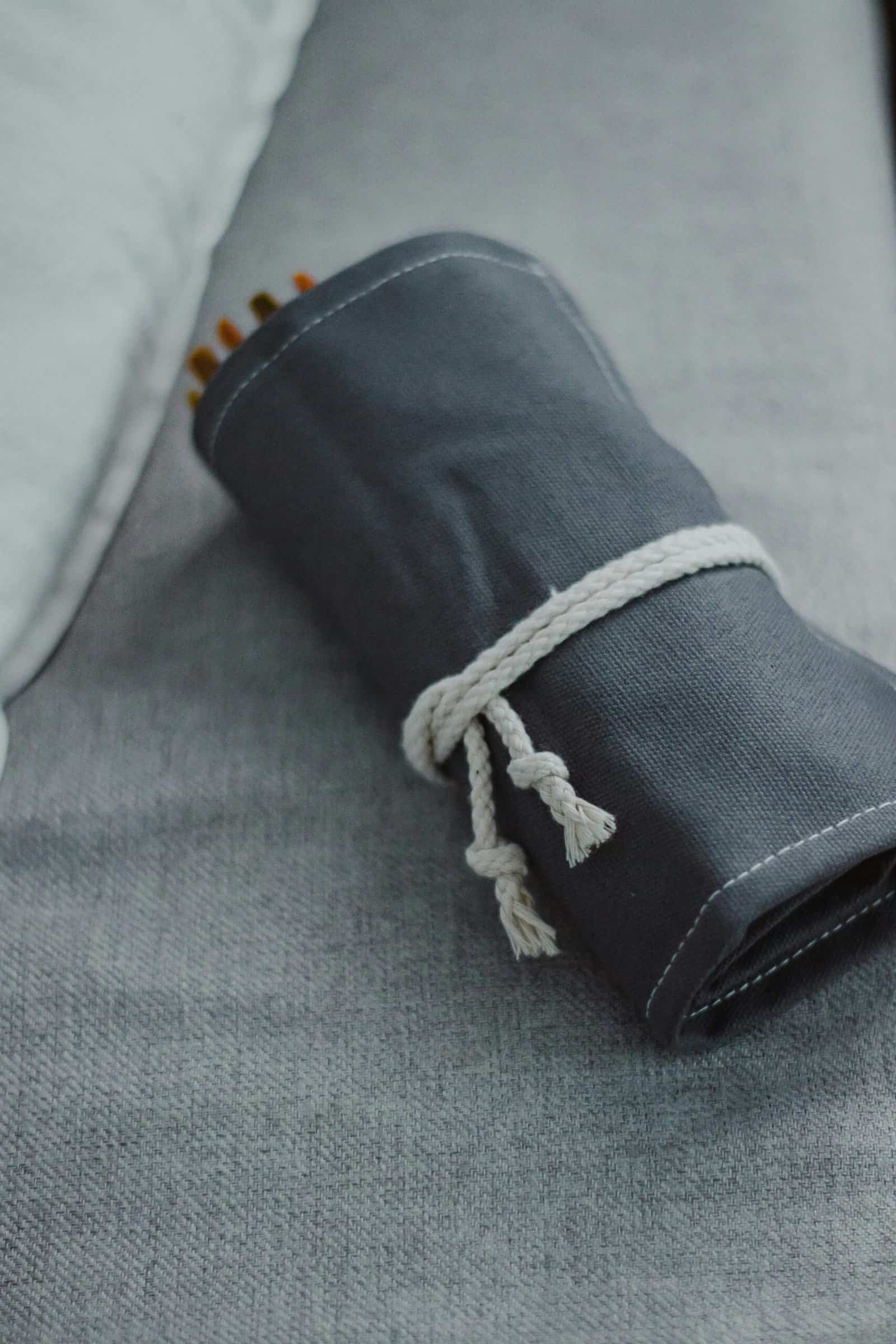
A knife roll protects the edge and everyone near it, and those are two separate problems. An unprotected blade in a bag dulls against whatever it touches and turns an ordinary journey into something genuinely dangerous. The right case depends on whether you carry three knives to a friend’s kitchen or twelve to a working shift. Our guide to storing knives safely covers the same problem at home.
Knife Carriers at a Glance
| Type | Capacity | Protection | Best for |
|---|---|---|---|
| Canvas or waxed roll | Six to twelve | Moderate, flexible | Working cooks |
| Hard case | Six to twenty | Highest | Air travel, valuable sets |
| Knife backpack | Ten plus tools | Good, padded | Commuting with a full kit |
| Individual edge guards | Per knife | Edge only | Occasional transport |
| Zippered pouch | Three to six | Basic | Short trips, few knives |
| Leather roll | Six to ten | Moderate, ages well | Presentation and gifts |
The short version: a canvas roll covers most working situations at the lowest cost. Move to a hard case if the knives are valuable or flying anywhere, and to edge guards alone if you carry two knives twice a year. Capacity is the specification people underestimate, since a roll bought to exactly fit your current knives has no room for the next one.
How We Picked
Carriers are grouped by how much protection they provide and how many blades they hold, since those decide whether a product suits a commute or a cupboard. Closure security is weighted heavily, because a roll that opens in transit is worse than no roll at all.
Descriptions come from how each construction behaves in transport rather than from time spent carrying a particular case.
1. A Canvas or Waxed Cotton Roll, Best Overall
Why It Stands Out
The standard chef’s roll holds knives in individual fabric slots, folds over the tips, and ties or straps closed. It is light, it packs into a bag, and it has been the working answer for a long time because the design does the job without complication.
Waxed cotton adds water resistance, which matters more than it sounds when a roll spends time on a wet worktop or travels in the rain. The wax wears off at the fold lines over a few years and can be reproofed, which is worth knowing before assuming a tired roll needs replacing.
Worth Knowing
Fabric slots do not stop a blade cutting through if the knife shifts, so the flap over the tips and a firm closure matter as much as the slots themselves. A roll that only ties loosely will let knives migrate.
Sizing is by slot width rather than knife length, and a wide cleaver or a long slicer may not fit a roll built around chef knives. Measure the widest blade you own before ordering. Our roundup of chef knives covers the sizes most rolls are built around.
This suits working cooks and anyone carrying a set regularly. Skip it for valuable knives going on a plane.
2. A Hard-Shell Knife Case, Best for Air Travel
Why It Stands Out
A rigid case with foam or molded inserts stops anything crushing or shifting, which is what checked baggage does to a soft roll. For expensive Japanese knives with thin edges, that protection is the difference between arriving usable and arriving chipped.
Lockable cases also satisfy the handling requirements that apply when knives travel as checked luggage.
Worth Knowing
Hard cases are heavy and bulky, and they do not fold into a bag when empty. They are transport equipment rather than something you carry daily.
Knives must go in checked baggage rather than cabin luggage on flights, and rules vary by carrier and country, so check before traveling rather than at the gate. Our note on German and Japanese knives covers which blades are most vulnerable to transit damage.
This suits flying and valuable sets. Skip it for a short drive across town.
3. A Knife Backpack, Best for Commuting
Why It Stands Out
Backpack-style bags carry knives in a padded internal roll plus room for a jacket, thermometer, notebook, and everything else a working shift needs. Carrying it on your back beats carrying a roll under one arm.
Separating knives from the rest of the kit also stops a thermometer scratching a blade in transit.
Worth Knowing
These are large and expensive compared with a plain roll, and much of the capacity goes unused if you only carry knives. Check that the knife section is genuinely separate rather than a pocket inside the main compartment.
Weight adds up quickly with a full set plus tools, and shoulder straps vary considerably in quality at this price.
This suits commuting cooks and culinary students. Skip it if knives are all you carry.
4. Individual Edge Guards, Best Minimal Option
Why It Stands Out
Plastic or felt-lined sheaths slide over the blade and protect the edge without any bag at all. For carrying two knives to a friend’s house, this is the whole solution for very little money.
They also earn their place at home, protecting knives stored flat in a drawer where a block or strip is not an option.
Worth Knowing
Guards protect the edge and do nothing to stop the knife moving inside a bag, so a loose guarded knife can still work free. Some cheap guards also trap moisture against the blade, which is a rust risk on carbon steel.
Fit is per knife, so a set of guards means matching each one to a blade rather than buying a universal size. Our note on why knives rust covers the moisture problem.
This suits occasional transport and drawer storage. Skip it as your only protection for a full set.
5. A Zippered Knife Pouch, Best for Small Kits
Why It Stands Out
A flat zip case holding three to six knives is more compact than a roll and closes completely, which suits anyone carrying a small working set rather than a full kit.
The zip closure also removes the roll-and-tie step, which matters when you are packing up at the end of a long day.
Worth Knowing
Capacity is fixed and small, so this is a purchase that constrains you if the collection grows. Zips are also the failure point, and a broken zip on a full pouch is a genuine problem.
Padding varies enormously in this category, and some pouches are little more than fabric envelopes. Check what sits between the blades.
This suits small kits and short journeys. Skip it if you own more than six knives you travel with.
6. A Leather Knife Roll, Best for Presentation
Why It Stands Out
Leather rolls look considerably better than canvas and develop a patina with use, which is why they are the common gift for someone who cooks seriously.
Heavier leather also holds its shape better than fabric, so knives sit more securely in the slots.
Worth Knowing
Leather is heavy, it does not like being soaked, and it needs occasional conditioning. In a working kitchen it will get treated the same as canvas and will not enjoy it.
Quality varies hugely at similar prices, and thin bonded leather offers no more protection than fabric while costing more. Our roundup of knife sets under 100 covers the knives that often arrive as gifts alongside these.
This suits gifts and occasional display. Skip it for daily working use.
What to Look For in a Knife Roll
How many knives, and how many later?
Buy capacity above your current set. Rolls sized exactly to what you own now become the reason you leave a knife behind, and collections grow.
Will your widest blade fit?
Slot width rather than length is the limiting dimension. Cleavers, slicers, and wide santokus defeat rolls designed around standard chef knives.
How does it close?
A tie, strap, or buckle that holds under weight is what stops knives shifting in transit. This is the specification that decides whether the roll actually works.
Is there a flap over the tips?
Without one, blades work upward out of their slots as the roll moves. A covered tip section is the difference between a roll and a fabric organizer. Our guide to looking after knives covers the wider care routine.
Roll or Hard Case?
The case for a roll
Light, compact, and it packs flat when empty. For carrying knives in a car or on foot, a roll does everything needed at a fraction of the weight and cost.
The case for a hard case
Nothing crushes or shifts, which is what checked baggage and rough handling require. For thin Japanese edges or an expensive set, the protection justifies the bulk. Our roundup of knife blocks and storage covers the at-home equivalent of the same decision.
Common Knife Transport Mistakes to Avoid
Loose knives in a bag
The edge dulls against everything it touches and anyone reaching into that bag is at real risk. This is the mistake worth eliminating first, and edge guards cost very little.
Buying for the current set
Collections grow, and a full roll means the newest knife travels loose. Extra slots cost almost nothing at purchase.
Ignoring the widest blade
Slot width defeats more rolls than length does. Measure a cleaver or wide santoku before ordering rather than assuming a chef knife roll accommodates everything.
Putting damp knives away
A blade rolled up wet stays wet, and fabric holds moisture against steel. Dry thoroughly before packing, particularly with carbon steel. Our comparison of stainless and carbon steel covers which blades are least forgiving about this.
Recommended Reading
See our roundup of magnetic knife strips, notes on sharpening a knife, our paring knife picks, and a guide to choosing a kitchen knife.
Knife Roll FAQ
How many knives should a roll hold?
More than you currently own. Most working cooks carry six to ten blades plus a steel and a peeler, and collections grow over time. A roll sized exactly to today’s set is the one that leaves a knife traveling loose in a bag next year.
Can I take knives on a plane?
Only in checked baggage, never in cabin luggage. Rules vary by carrier and country, so confirm before traveling. A hard case is the sensible choice for checked bags, since soft rolls offer little protection against how luggage gets handled.
Do I need edge guards inside a roll?
Not usually, since the fabric slots keep blades separated. Guards are worth adding if the roll is loose, if you carry it in a larger bag with other equipment, or if a particular knife has an edge you are unwilling to risk.
Is leather better than canvas?
For appearance and longevity, yes. For working use, canvas or waxed cotton is lighter, cheaper, and handles moisture better. Leather is a good gift and an awkward daily companion in a busy kitchen.
How do I stop knives sliding out of the slots?
Look for a roll with a flap covering the tips and a closure that holds firmly. Without a tip flap, blades work upward as the roll moves. A loose tie is the most common reason knives migrate in transit.
Can I put a cleaver in a standard knife roll?
Often not. Slot width rather than blade length is the limiting factor, and rolls built around chef knives rarely accommodate a wide cleaver. Measure the widest blade you own against the stated slot dimensions before ordering.
How should I clean a knife roll?
Empty it, shake out debris, and spot clean fabric rather than machine washing, which degrades stiffening and waxed finishes. Leather needs a damp cloth and occasional conditioner. Let anything damp dry fully open before rolling it up.
Are knife backpacks worth the extra cost?
If you carry tools, a jacket, and a notebook alongside knives, yes, since everything travels in one bag with your hands free. If knives are all you carry, a plain roll does the same job for far less money and weight.
