
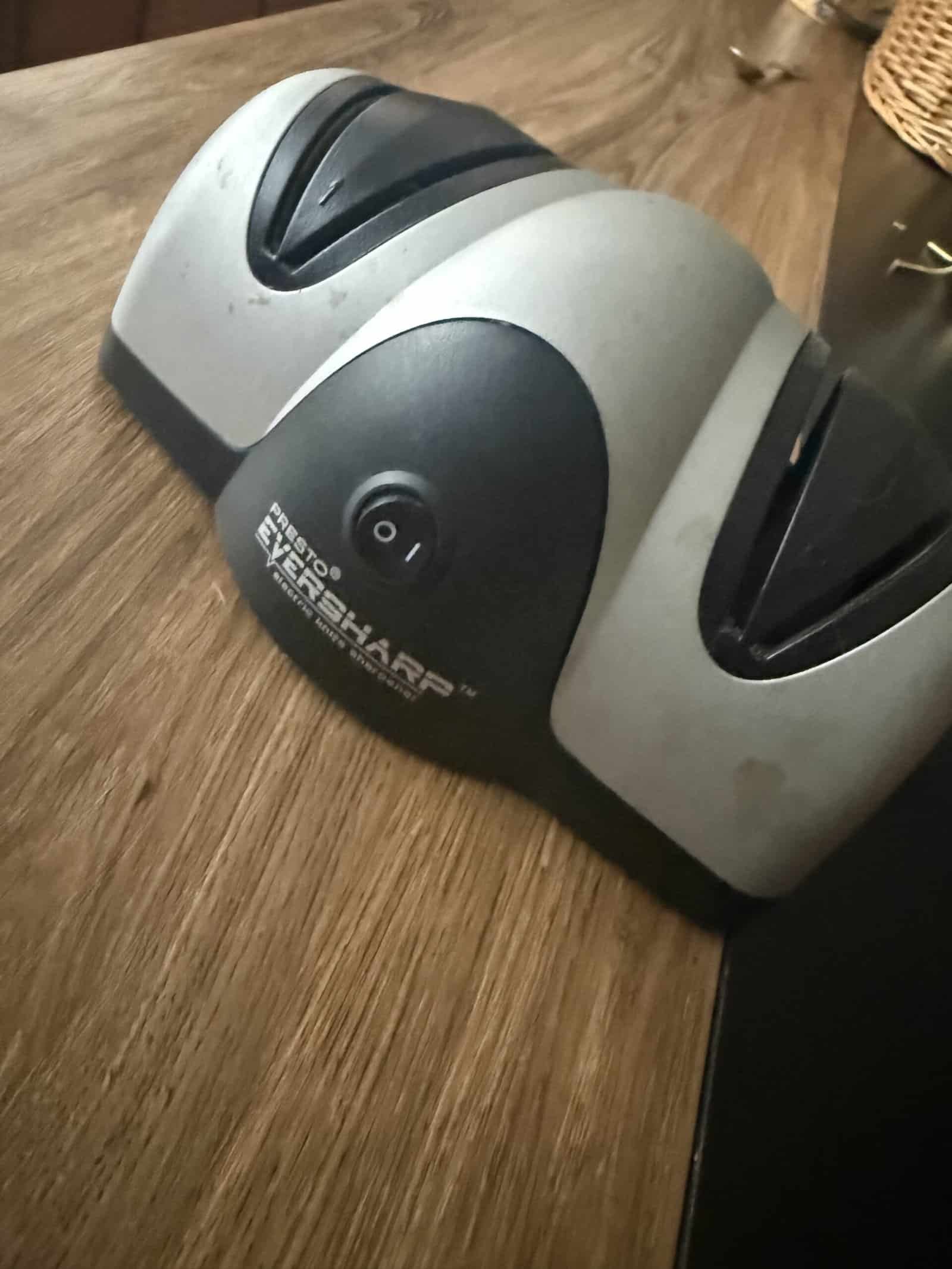
A good electric knife sharpener brings a dull kitchen knife back to a clean cutting edge in about 60 to 90 seconds per blade. Electric knife sharpeners do this with motorized abrasive wheels that hold the angle for you, which is the part most home cooks struggle with by hand. For most kitchens, a three-stage countertop model is the right buy, because the extra polishing stage leaves a finer edge without asking anything more of you.
Skip the electric route only if you own thin Japanese blades or you already enjoy freehand work on a whetstone. Everyone else gets more usable sharpness per dollar here than from any other tool. If you are still weighing the whole category, our guide to picking a sharpener for your kitchen covers manual options too.
Electric Knife Sharpeners at a Glance
| Category | Best For | Typical Price | Score |
| Two-Stage Countertop | Everyday home kitchens | ~$45 | 8.6/10 |
| Three-Stage Countertop | Mixed knife collections | ~$80 | 9.2/10 |
| Compact Single-Slot | Small kitchens and dorms | ~$25 | 8.0/10 |
| Belt-Driven | Very dull or damaged blades | ~$110 | 8.8/10 |
| Electric and Manual Combo | Quick touch-ups between uses | ~$60 | 8.4/10 |
| Adjustable Angle Guide | Japanese and Western blades | ~$95 | 9.0/10 |
Key Points
- Most electric sharpeners work in stages, moving from coarse grinding to fine polishing in one pass.
- A fixed 20-degree angle suits Western knives, while Japanese blades usually want 15 degrees.
- Belt-driven units remove the most metal, so they rescue bad edges but shorten blade life fastest.
- Two or three sharpening sessions a year is plenty for a typical home cook.
- Honing between sharpenings keeps the edge straight and stretches the time between sessions.
- No electric sharpener handles serrated bread knives well unless it has a dedicated serrated slot.
How We Picked
We started with the question that actually decides satisfaction: does the machine hold the angle so you do not have to? The ones that fail here produce a rounded, uneven edge no matter how careful you are.
Next we weighed metal removal against edge quality. Aggressive wheels fix a badly abused knife quickly, but they eat blade width every session.
I keep a countertop electric knife sharpener in my own kitchen and run all my knives through it now and then. My verdict is that it does the job well while not being perfect, and the imperfect part is that it is sometimes difficult to use. That single point shaped how much weight we gave to ease of use across the whole list.
Finally we looked at storage and frequency of use. I sharpen less than once a month, with the electric sharpener and nothing else, and it lives in a cabinet where I put it away most of the time. A sharpener you have to wrestle out of storage needs to justify the trip, which is why footprint and setup time carried real weight in the rankings.
1. A Two-Stage Countertop Sharpener, Best Overall
Why It Stands Out
The two-stage countertop unit is the default for a reason. One coarse slot cuts a fresh bevel, and one fine slot cleans it up. That covers the entire life cycle of a normal kitchen knife.
Guides on both sides of each slot press the blade against the wheel at a fixed angle, so nothing about the process asks for skill.
This is the countertop electric style I use at home. The same two slots take a chef knife, a paring knife, and a santoku without any adjustment between them.
Worth Knowing
Two stages means no true polishing step. The edge you get is sharp and functional, but it will not have the mirror finish a third stage produces.
These units also remove more metal than a honing pass does. Use the coarse slot only when the knife is genuinely dull. Running both slots every time wears blades down faster than necessary, which our notes on keeping knives in good shape explain in more detail.
Pick this if you cook regularly, own standard Western knives, and want one appliance that just works. Skip it if your collection leans Japanese or you already own a whetstone and enjoy using it.
2. A Three-Stage Countertop Sharpener, Best for Dull Edges
Why It Stands Out
Adding a third stage changes the result more than the spec sheet suggests. Stage one grinds, stage two sharpens, and stage three polishes with a fine abrasive or a stropping surface. The finished edge glides through a tomato skin instead of pressing into it.
That polishing pass also helps the edge last longer. A refined edge has fewer microscopic burrs to fold over during use.
Many three-stage units include a separate serrated slot as well. That single feature makes the machine useful for a whole class of knives the others ignore, including most of the serrated loaf knives worth owning.
Worth Knowing
Three stages means a bigger footprint and a heavier body. Budget real cabinet space before you buy.
The price climbs too, usually landing near $80. That is still less than replacing two decent knives.
Choose this if you own a mixed set with both smooth and serrated blades and you want the best everyday edge available without technique. Pass on it if counter space is genuinely tight or you only own two knives.
3. A Compact Single-Slot Sharpener, Best Budget
Why It Stands Out
Single-slot models strip the category down to one job. A single set of wheels handles both grinding and finishing at a compromise grit. The whole unit often fits in a deep drawer.
For apartments, dorms, and RV kitchens, that footprint matters more than edge refinement. You get a knife that cuts cleanly again in under a minute.
Compact units sit around $25, which is roughly the cost of one mid-range paring knife. Anyone building a first kitchen can justify that easily, especially alongside one of the affordable starter knife sets we like.
Worth Knowing
The compromise grit is a real limitation. A badly damaged edge takes many more passes here than it would in a coarse slot.
Motors in this class are smaller and run warmer. Long sessions can heat a thin blade near the tip. Work in short bursts and let the knife cool between passes.
This one suits renters, students, and anyone with two or three knives and no counter to spare. Look elsewhere if you own a full block set or expect to rescue a badly neglected edge.
4. A Belt-Driven Sharpener, Best for Control
Why It Stands Out
Belt sharpeners replace rigid wheels with a flexible abrasive belt. The belt conforms slightly to the blade, which produces a subtle convex edge. That shape is unusually durable in daily use.
Belts also remove metal fast. A chipped or badly rolled edge that would defeat a wheeled unit comes back in a few passes.
Swappable belts add flexibility no other category matches. Coarse belts reprofile, fine belts polish, and leather belts strop. One machine covers the whole range, which is why people who like sharpening by hand often end up here.
Worth Knowing
Belt units remove metal quickly enough that a careless minute can visibly narrow a blade. Light pressure and steady movement are not optional.
They also cost the most, often near $110 with belts. Expect to buy a set every year or two with regular use.
Get this if you have several neglected knives, outdoor blades, or shop tools to bring back. Avoid it if your knives are already in decent shape and you only want maintenance.
5. A Combination Electric and Manual Sharpener, Best Versatility
Why It Stands Out
Combination units pair motorized coarse stages with a manual pull-through finishing slot. The motor does the heavy grinding, and your hand controls the final pass.
The manual slot draws no power, so quick touch-ups take seconds. You can pull a knife through mid-cook without waiting for a motor to spin up.
This design also bridges toward traditional maintenance tools. If you already keep a honing steel by the block, the manual slot fits the same habit. The electric stages then become an occasional reset rather than a routine.
Worth Knowing
The manual slot is not a substitute for real sharpening. It realigns and lightly refines an edge that is already close.
Build quality varies more in this category than any other. Cheap combination units often have loose manual guides that wobble under pressure. Check that the manual slot feels rigid before committing.
Buy this if you cook most nights and want a fast touch-up option always within reach. Skip it if you would rather own one tool that does one thing properly.
6. A Sharpener with an Adjustable Angle Guide, Best for Mixed Knife Sets
Why It Stands Out
Adjustable-angle units let you set the bevel yourself, usually between 15 and 20 degrees. Western knives take the wider angle for durability. Japanese knives take the narrower one for slicing performance.
That flexibility solves the biggest problem with fixed-angle machines. Forcing a 15-degree Japanese blade through a 20-degree guide grinds away the very geometry you paid for.
The mechanism is simple to operate despite the added capability. Anyone comparing chef knives across both traditions should factor this in before buying a sharpener.
Worth Knowing
You do have to know your knife’s angle. Guessing wrong wastes metal and produces an inconsistent bevel. Manufacturer specs or a quick measurement solve it in a minute.
Adjustable units also cost more, around $95, and add moving parts that can drift out of calibration. Check the setting each session rather than assuming it held.
This is the pick for anyone with a mixed Western and Japanese collection or a knife they care about protecting. It is overkill if every knife you own came from the same block set.
What to Look For in an Electric Sharpener
How Many Stages Do You Actually Need?
Two stages cover the basics for a standard Western kitchen. Three stages add a polishing pass that produces a noticeably finer edge. A fourth serrated slot only matters if you own serrated knives you want to maintain.
More stages also mean more time per knife. Decide whether the finer edge is worth the extra minute.
What Angle Should the Sharpener Set?
Most Western chef knives are ground near 20 degrees per side. Japanese blades typically sit closer to 15 degrees. A sharpener locked to the wrong number will reshape your blade permanently.
Check the angle spec before anything else. Adjustable units cover both ranges and cost more for the privilege.
How Aggressive Are the Abrasives?
Diamond abrasives cut fast and stay flat for years. Ceramic wheels cut more gently and refine better. Belt systems sit at the aggressive end and remove the most material per pass.
Match the abrasive to your knives’ condition. Neglected edges want aggression, and well-maintained edges want restraint.
Where Will the Sharpener Live?
Countertop units earn their place only if you use them often. A machine stored in a cabinet gets used less than one left out. Be honest about which describes your kitchen.
Weight matters here too. Heavier units stay put during a pass, but they are a chore to move.
Electric vs Manual Sharpening
When Electric Wins
Electric sharpeners win on speed and consistency. The motor and guides deliver the same angle on every pass, which no beginner achieves by hand. A dull knife becomes usable in under two minutes.
They also lower the barrier to actually doing the job. Sharpening that takes 90 seconds gets done, and sharpening that takes 20 minutes gets postponed.
When Manual Wins
Whetstones and honing rods remove far less metal per session. A knife maintained by hand can last decades longer than one run through aggressive wheels. That difference compounds over years, and our piece on whether electric sharpeners harm blades works through the trade-off.
Manual tools also handle shapes machines cannot. Curved blades, single-bevel knives, and shears all need hand work. For those, see our walkthrough on restoring an edge on kitchen shears.
Common Misconceptions
Electric Sharpeners Ruin Every Knife
They remove more metal than a whetstone, which is true. They do not ruin knives when used correctly and infrequently. The damage stories almost always involve running the coarse stage every week.
A Sharper Knife Is More Dangerous
Dull knives slip off food and require force, which is how most kitchen cuts happen. A sharp blade bites where you place it.
Honing and Sharpening Are the Same Thing
Honing straightens an edge that has folded over during use. Sharpening removes metal to create a new edge. You should hone often and sharpen rarely.
You Need to Sharpen Every Month
Most home cooks sharpen two or three times a year. Frequency depends on how much you cook and what surface you cut on. Wood and plastic boards preserve edges far better than glass or stone.
Worth reading next: if you are deciding whether to sharpen or start over, our take on when a knife is past saving gives you a clear cutoff. Storage matters just as much, so read what we found about magnetic strips and blade wear before you mount one. And if you are filling gaps in your collection, our guide to flexible knives for breaking down meat is a good next stop.
Frequently Asked Questions
Are electric knife sharpeners good for expensive knives?
They can be, provided the angle matches, because a 20-degree fixed unit will reshape a 15-degree Japanese blade and grind away metal you paid for. For premium knives, buy an adjustable-angle model or sharpen by hand instead. Mid-range Western knives take fixed-angle machines without any real downside.
How often should I run my knives through one?
Two to three times a year covers most home kitchens, though heavy daily cooking might push that to four. Between sessions, use a honing rod weekly to keep the edge straight and delay the next full session. Over-sharpening is a far more common mistake than under-sharpening.
Can electric sharpeners handle serrated knives?
Only if the unit has a slot built specifically for serrations, since standard slots will flatten the scallops and destroy the cutting pattern. Some three-stage countertop models include a dedicated serrated stage for exactly this reason. Check the spec before putting a bread knife anywhere near the machine.
Why does my knife still feel dull after sharpening?
Usually a burr is still clinging to the edge and folding over as you cut. Run the knife through the finest stage two or three more times with very light pressure. If that fails, the coarse stage never reached the apex, so start over and take more passes there.
Does an electric sharpener work on ceramic knives?
Standard steel-oriented wheels will not touch ceramic, so you need diamond abrasives, which only some units actually use. Even then, ceramic chips rather than rolls, which makes results vary widely from blade to blade. Sending ceramic knives back to the maker is often the better call.
How much should I spend on one?
Around $45 buys a capable two-stage unit that suits most kitchens, and spending $80 adds a polishing stage plus a serrated slot. Past $100 you are paying for belt systems or angle adjustment. Below $25, build quality drops off sharply and the guides start to wobble.
Will sharpening shorten the life of my knives?
Every sharpening removes metal, so technically yes, but a well-treated knife survives decades of correct sharpening. The blades that wear out early belong to people who run the coarse stage every single week. Sharpen only when the knife has genuinely gone dull and it will outlast you.
