
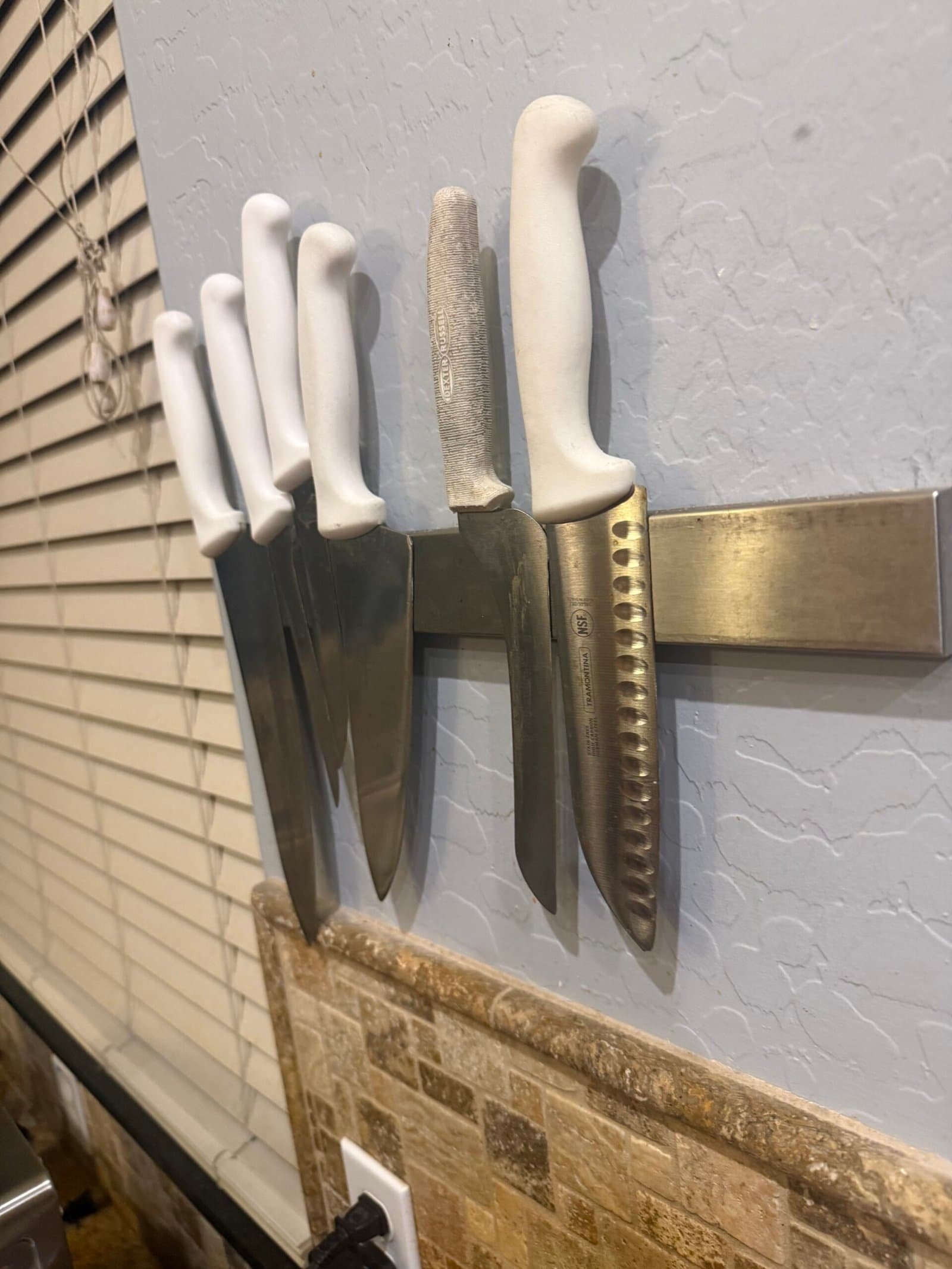
Pick a magnetic strip if counter space is tight and your knives vary in size, and pick a block if you want knives covered, portable, and out of sight. The strip mounts on the wall and holds anything you put on it, while the block sits on the counter and holds only what fits its slots.
Both keep edges off the inside of a drawer, which is the actual point. Everything after that is a question of what your kitchen has spare, wall or counter.
Quick Verdict
Choose a magnetic strip when counter space is the constraint, when your knives are mismatched, or when you want to see what you are reaching for. Choose a block when you want blades enclosed, when you rent and cannot drill, or when exposed knives near children concern you.
Key Takeaways
- Strips free counter space and blocks consume it
- Strips accept any knife, blocks only accept what fits the slots
- Blocks hide blades, which matters with children in the kitchen
- Strips need wall access and a drill, so renters should check first
- Block slots trap moisture and crumbs where you cannot see them
- Exposed blades on a strip catch light, which some people find distracting
How We Compared
Storage decisions come down to four things: what space the tool costs you, whether your knives fit, how the edges hold up, and whether the setup suits the people in your kitchen.
Price separates them less than expected, since a decent strip and a decent block land in similar territory once you get past the bundled sets. Buying a block that arrives full of knives is a different purchase entirely, covered in knife sets under a hundred. Neither storage method is automatically gentler, and our note on magnets and knife edges covers the difference.
Edge protection matters to both and neither is dangerous to a blade when used properly. What differs is what happens to the knife between uses, and that is where the two diverge.
Strip vs Block at a Glance
| Criterion | Magnetic strip | Knife block |
|---|---|---|
| Counter space used | None | Meaningful footprint |
| Wall space needed | Yes, and a drill | None |
| Accepts any knife | Any steel blade, any size | Only what fits the slots |
| Blades visible | Fully exposed | Enclosed |
| Child safety | Depends on mounting height | Better, blades covered |
| Cleaning | Wipe the bar, that is all | Slots trap crumbs and moisture |
| Portability | Fixed once mounted | Moves anywhere |
| Renter friendly | Requires permission to drill | Yes |
Magnetic Strip, Pros and Cons
- Costs no counter space at all, which is the main reason people switch
- Holds any blade regardless of size, including ones no block would fit
- You see every knife, so you grab the right one without hunting
- Wipes clean in seconds with nothing to trap debris
- Needs wall space and drilling, which rules it out in some kitchens
- Exposed blades catch light and reflect it, which some people find distracting
Best for small kitchens, mismatched knife collections, and anyone who wants their tools visible. Skip it if you cannot drill, if you have young children who can reach the mounting height, or if you want blades out of sight.
Knife Block, Pros and Cons
- Blades stay enclosed, which is the safety argument
- Needs no wall, no drill, and no landlord conversation
- Moves with you and moves around the counter
- Consumes counter space permanently, and small kitchens feel it
- Slots only fit the knives the block was designed for
- Enclosed slots hold moisture and crumbs where you cannot inspect them
Best for renters, kitchens with children, and anyone who bought a matched set. Skip it if counter space is your constraint or if your knives came from different places over time.
Which Saves More Space?
The strip wins outright, and this is the criterion that decides it for most people.
A block occupies counter permanently. In a kitchen where prep space is already tight, giving up a corner to store tools you use for minutes a day is a poor trade, and it is the complaint that sends people to strips.
A strip uses wall, which in most kitchens is the surface nobody is competing for. Mounted above the counter or beside a work area, it costs you nothing you were using.
The catch is that not every kitchen has usable wall. Tiled backsplashes, window placement, and cabinet runs can leave you with no continuous stretch long enough to be useful.
Which Handles a Mismatched Collection?
The strip wins, and it is not close.
Blocks are built around a specific set of knives. Slots are sized for particular blade lengths and widths, and a knife bought later frequently will not fit any of them. Universal blocks with flexible inserts solve this and cost more.
A magnetic strip does not care. Any steel blade sticks to it, in any size, from a paring knife to a cleaver. Knives accumulate over years rather than arriving together, and a strip accommodates that without any planning.
If you own a matched set and intend to keep it that way, this criterion does not apply to you and the block is fine. Choosing the knives themselves is covered in choosing a kitchen knife.
Which Is Safer?
The block wins where children are involved, and the strip is fine otherwise.
A block encloses the blades. A child pulling at the counter finds handles, not edges, and that is a meaningful difference for anyone with small children in the kitchen.
A strip holds blades exposed at whatever height you mounted it. Mounted high, that is a non-issue. Mounted at counter height in a home with toddlers, it is worth thinking about.
For adults, both are safe when used correctly. Placing a knife on a strip means laying the spine against the magnet first and rolling the blade on, rather than slapping it flat, which protects the edge.
Which Is Easier to Keep Clean?
The strip wins, and it is the criterion people forget until they own a block.
Block slots are narrow, deep, and closed at the bottom. Crumbs fall in, moisture from a not-quite-dry knife follows, and neither comes out easily.
A strip is a bar on a wall. Wipe it when you wipe the wall. There is nowhere for anything to accumulate.
This connects to how knives get dried in the first place, and putting a wet knife anywhere causes trouble. Why knives rust covers the mechanism.
What I Use and What Bothers Me
I use a magnetic strip, mounted on the wall right next to the sink. All my cooking knives live on it, and my steak knives are stored somewhere else entirely, which is worth saying because a strip does not have to hold everything.
I used a block before this. The switch was about counter space, and I have not wanted to go back. Being able to see every knife rather than reading handle shapes to work out which is which turned out to matter more than I expected.
The honest annoyance is glare. Exposed blades next to a sink catch the light and throw it back at you, and depending on where you stand it is genuinely distracting. Nobody mentions this before you mount one. It is not enough to make me switch back, and it is a real downside that the product descriptions skip.
My experience covers one strip in an apartment kitchen with a mix of stainless knives. It does not cover mounting on tile or plaster, and it does not cover households with young children, where the exposed blade question deserves more weight than I can give it.
Which Fits Your Situation
| If this is you | Better choice |
|---|---|
| Counter space is your binding constraint | Strip |
| You rent and cannot drill | Block |
| Young children reach your counters | Block |
| Your knives came from different places | Strip |
| You bought a matched set with a block included | Block |
| You want to see what you are grabbing | Strip |
| You move house often | Block |
| Your kitchen has no usable wall run | Block |
How to Choose Between Them
Measure before deciding anything. A strip needs a continuous stretch of wall clear of cabinets, outlets, and windows. A block needs counter you are willing to give up permanently.
Count your knives and note their lengths. A collection that grew over years favors the strip, and a matched set favors the block.
Think about who else is in the kitchen. That single factor overrides most of the rest where small children are concerned.
The Verdict
The strip wins on space, flexibility, visibility, and cleaning. The block wins on enclosed blades, portability, and not needing to touch the wall.
Small kitchen, mixed knives, adults only: strip. Renting, matched set, children around: block. Comparing specific options, magnetic strips worth mounting covers magnet strength and mounting types, and knife blocks and storage covers slot layouts and universal designs.
Recommended Reading
- storage options beyond these two
- the knife most people reach for first
- what the dishwasher does to an edge
- checking an edge before you blame storage
- the in-drawer alternative
- knives that live somewhere else
Common Mistakes
Slapping the blade flat onto a strip
Lay the spine against the magnet first and roll the blade down. Slapping the edge flat against steel is how people chip a knife on a strip, and it is entirely avoidable.
Putting a damp knife into a block
Slots hold moisture against the blade with no airflow. Dry knives fully before storing them anywhere, and especially before sliding them into an enclosed slot.
Mounting a strip that is too weak
A strip rated for light blades will not hold a chef knife securely. Check the magnet strength against your heaviest knife rather than your average one.
Strip vs Block FAQ
Does a magnetic strip damage knives?
Not when used correctly. Lay the spine against the magnet and roll the blade on rather than slapping it flat. The magnetism itself does nothing harmful to the steel.
Which saves more space?
The strip, since it uses wall rather than counter. In a kitchen where prep space is tight, a block consumes a corner permanently to store tools you use for a few minutes a day.
Are knife blocks unhygienic?
They can be. Slots are narrow, deep, and closed, so crumbs and moisture collect where you cannot see or reach them. Blocks that can be inverted and emptied are easier to keep clean.
Can renters use a magnetic strip?
Only with permission to drill, since a strip holding heavy knives needs proper wall fixings. Adhesive mounting is not reliable enough for blades at head height.
Is a block safer with children?
Generally yes, since the blades stay enclosed and a child finds handles rather than edges. A strip mounted well above reach is also fine, so mounting height decides it more than the format does.
Can I use both?
Plenty of kitchens do. A strip for the knives you use daily and a block or drawer for the rest, including steak knives, which rarely need to be within arm’s reach of the stove.
Storage format affects the whole kitchen layout. arranging a kitchen covers the wider plan.
