
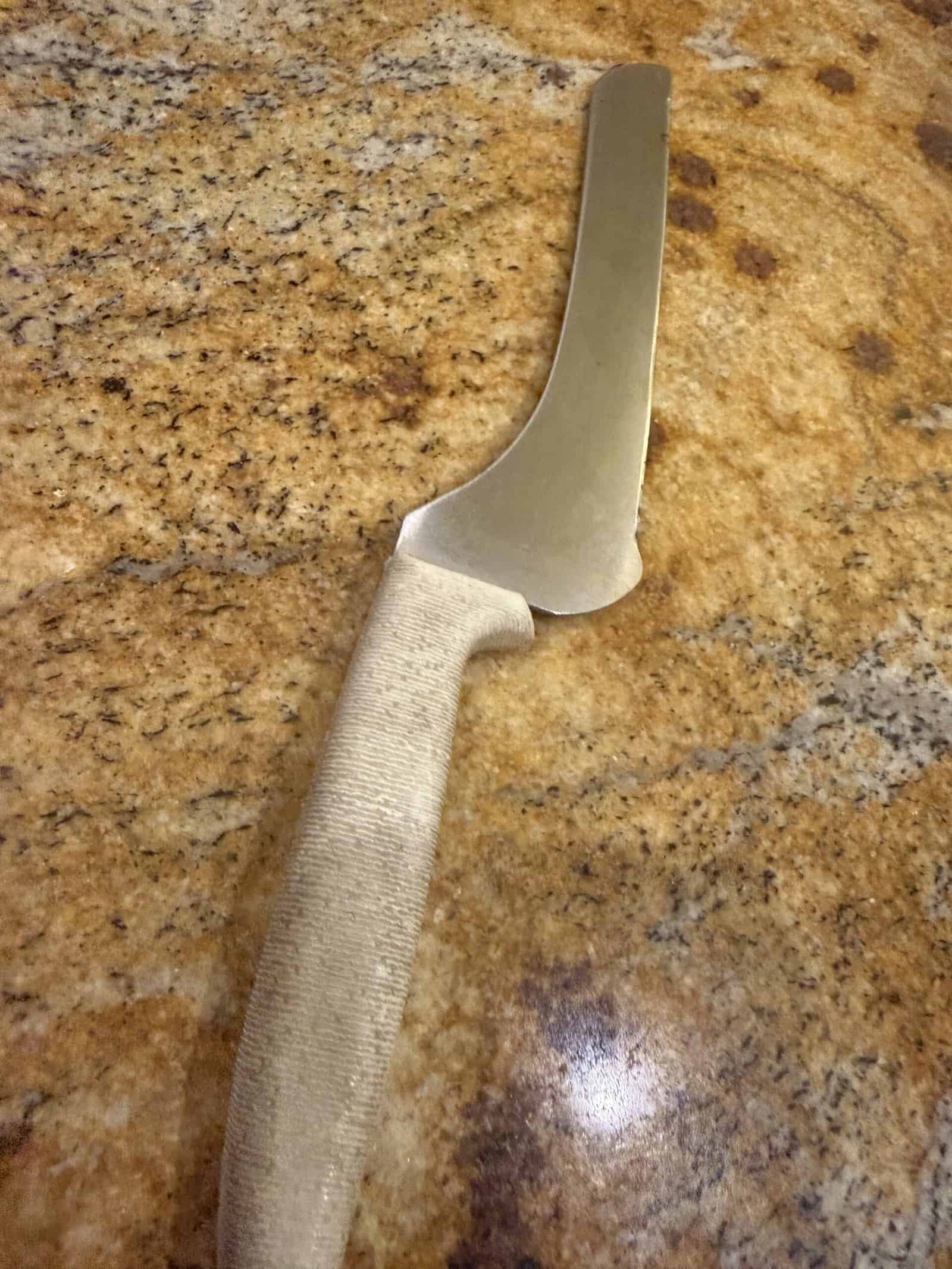
A bread machine loaf is tall, soft, and often narrower at the base than the top, which is the worst combination for slicing by hand. It wants to tip, the knife wants to compress rather than cut, and the slices come out wedge-shaped. A slicing guide holds the loaf square and gives the blade something to run against, which fixes both problems at once. Our roundup of bread knives covers the blade side.
Slicing Options at a Glance
| Type | Holds the loaf | Even slices | Storage |
|---|---|---|---|
| Folding slicing guide | Yes, upright | Yes, fixed widths | Folds flat |
| Adjustable guide | Yes | Yes, variable | Bulkier |
| Bamboo slicing board | Partly | Somewhat | Flat, heavy |
| Serrated bread knife alone | No | Depends on you | Knife block |
| Electric knife | No | Good on soft loaves | Drawer or cabinet |
| Manual slicer with blade | Yes | Most consistent | Largest |
The short version: a folding guide plus a decent serrated knife handles machine loaves for very little money and stores flat. Everything above that solves narrower problems.
How We Picked
Options are grouped by whether they hold the loaf, guide the blade, or do both, since those are different failures. Storage is weighted alongside performance, because a slicing aid that lives in a cupboard behind other things stops getting used.
Selections reflect construction and slot design. Descriptions come from product research except where personal use is stated directly.
1. A Folding Slicing Guide, Best Overall
Why It Stands Out
Slotted guides hold the loaf upright between side walls and give the knife a channel to follow, which produces even slices without any skill on your part.
Folding versions collapse flat, so the thing lives in a drawer rather than occupying counter space between loaves. That matters more than it sounds, since slicing aids are used briefly and stored for days.
Worth Knowing
Slot spacing is fixed, so you get the widths the guide offers rather than the width you fancy. Most have two or three options.
Check the internal height against a machine loaf, since some guides are sized for shop-bought loaves and a tall vertical loaf will not fit. Our note on machines for sandwich loaves covers loaf shapes.
This suits most home bakers. Skip it if your loaves are unusually tall.
2. An Adjustable Slicing Guide, Best for Control
Why It Stands Out
Adjustable guides let you set thickness rather than choose from preset slots, which matters if you want thin slices for toast and thick ones for sandwiches from the same loaf.
They also accommodate a wider range of loaf sizes than fixed-slot designs, which helps if you bake both vertical machine loaves and horizontal ones.
Worth Knowing
Adjustment mechanisms add bulk and rarely fold as flat as a simple slotted guide.
They also introduce something that can loosen over time, at which point slices drift in thickness. Our note on storing bread covers what happens after slicing.
This suits varied slice thickness. Skip it if one width covers your use.
3. A Bamboo Slicing Board, Best Simple Option
Why It Stands Out
Boards with a raised lip and shallow grooves catch the loaf and collect crumbs, which handles the mess without adding a separate object to the cupboard.
They double as a serving board, so the thing earns its space twice, which is a fair argument in a kitchen short on storage.
Worth Knowing
A board guides the knife far less than a slotted guide does, so slice consistency still depends on your hand. It stops the loaf sliding rather than holding it upright.
Bamboo needs occasional oiling and dislikes the dishwasher. Our guide to cleaning a cutting board covers care.
This suits tidy slicing and serving. Skip it if even slices are the goal.
4. A Long Serrated Bread Knife, Best Foundation
Why It Stands Out
No guide compensates for a short or dull blade. A serrated knife long enough to cross the loaf in one pass cuts rather than compresses, which is the difference on a soft machine loaf.
Length matters more than sharpness here, since a sawing motion across a soft crumb tears it. One long draw beats several short passes on any soft loaf.
Worth Knowing
Serrated edges are difficult to sharpen at home, so most people replace rather than restore them. That is fine at moderate prices.
Blade length should exceed the loaf width with room to spare. Our roundup of knife storage covers keeping the edge protected.
This suits everyone who bakes. Skip it only if you already own a good one.
5. An Electric Knife, Best for Soft Loaves
Why It Stands Out
Twin reciprocating blades cut soft bread without compressing it, which is exactly the failure mode of a still-warm machine loaf under a manual knife.
They also require very little downward pressure, so the loaf stays where it is.
Worth Knowing
Electric knives are bulky, need storing, and are a single-purpose appliance in a kitchen that probably already has enough of those.
They also do not hold the loaf, so an unsteady loaf is still unsteady. Our note on storing small appliances covers where things like this end up.
This suits soft and warm loaves. Skip it if cupboard space is short.
6. A Manual Slicer With a Fixed Blade, Best Consistency
Why It Stands Out
Countertop slicers with their own blade produce the most uniform slices available at home, since neither the loaf nor the blade moves freehand.
For anyone baking weekly and wanting shop-consistent slices, this is the tool that gets there.
Worth Knowing
These are large, and in a kitchen where the bread machine already lives in a cabinet, a second bulky object is a real cost.
Exposed blades also need respectful handling and careful cleaning. Our note on whether bread machines are worth it covers the counter space question.
This suits frequent bakers with space. Skip it for occasional baking.
How I Slice Mine
I use a bread knife and no guide. It works, and the honest description is that machine loaves give me a little trouble staying upright sometimes.
That is the specific problem, and it is worth naming because it is not about the knife. A vertical machine loaf has a small footprint relative to its height, so it wants to tip as soon as you apply sideways pressure. A shop loaf sits flatter and behaves better.
It has never bothered me enough to buy anything for it, which tells you the size of the problem. Slices come out slightly uneven and the bread tastes the same either way, so a guide has stayed on the list of things I have not needed.
I am baking often at the moment, and if that keeps up, or if I wanted sandwich slices that matched each other, a folding guide is what I would look at first on the grounds that it stores flat. What I cannot tell you is how much difference one makes in practice, since I have not used one.
What to Look For
Will a machine loaf fit?
Vertical loaves are taller than shop-bought ones, and some guides are sized for the latter. Check internal height before buying.
Does it hold the loaf or just guide the knife?
Tipping and uneven slices are separate problems. Slotted guides address both; a board addresses only the sliding.
Where will it live?
Anything that does not fold or stack tends to end up behind other things and stop being used. Folding designs survive this better.
Is your knife long enough?
A blade that cannot cross the loaf in one pass means sawing, which tears soft crumb. No guide fixes a short knife.
Guide or Just a Better Knife?
Start with the knife
A long serrated blade solves compression and tearing, which is most of what goes wrong. If slices are ragged rather than uneven, the knife is the problem.
Add a guide for consistency
If slices are clean but wedge-shaped, or the loaf tips while you cut, the knife is fine and the loaf needs holding. That is what a guide does and a knife cannot. Our note on machine and oven baking covers the loaf shapes each produces.
What Trips People Up
Slicing a warm loaf
Warm bread compresses under any blade and steams itself soggy once bagged. Let it cool fully before cutting.
Buying a guide sized for shop loaves
Machine loaves are taller. A guide that will not accept the loaf is useless regardless of how well it works otherwise.
Pressing down instead of drawing across
A serrated blade cuts on the draw. Downward pressure crushes the crumb, which is the most common cause of squashed slices.
Ignoring where it will be stored
Slicing aids are used for two minutes and stored for days. If it does not fold or stack, it will end up behind the stand mixer. Our note on kitchen tools you never use covers that pattern.
Worth reading next: our guide to making white bread in a bread machine, our note on why bread goes stale, our bread box picks, and a roundup of bread machines.
Bread Slicing FAQ
Why do my bread machine loaves slice unevenly?
Vertical machine loaves are tall with a small base, so they tip under sideways pressure from the knife. That produces wedge-shaped slices even with a good blade. Holding the loaf square is what fixes it, which is what a slotted guide does.
Do I need a slicing guide or just a better knife?
Ragged, torn slices point at the knife, usually one too short or too dull. Clean but uneven slices point at the loaf moving, which is a guide problem. Diagnosing which you have saves buying the wrong thing.
Will a slicing guide fit a bread machine loaf?
Not always. Many guides are sized for shop-bought loaves, which are shorter and wider than a vertical machine loaf. Check the internal height against your loaf before buying.
How long should a bread knife be?
Long enough to cross the loaf in a single pass with room to spare, which usually means at least ten inches for machine loaves. A shorter blade forces a sawing motion that tears soft crumb.
Should I slice bread warm or cold?
Fully cool. Warm bread compresses under the blade, giving squashed slices, and it continues releasing steam, which turns the crust soft once bagged. Waiting is the single easiest improvement to slicing.
Are electric knives good for bread?
They handle soft loaves well, since the reciprocating blades cut without needing downward pressure. The trade is bulk and single-purpose storage, and they do not hold the loaf steady, so tipping remains your problem.
Can I sharpen a serrated bread knife?
Only with a tapered rod worked through each serration, which is slow and fiddly. Most people replace inexpensive serrated knives rather than restoring them, and at moderate prices that is a reasonable approach.
Is a countertop slicer worth it?
For weekly baking and shop-consistent slices, it produces the best results available at home. For occasional baking it is a large object used briefly, which in most kitchens is a poor trade against a folding guide that stores flat.
