
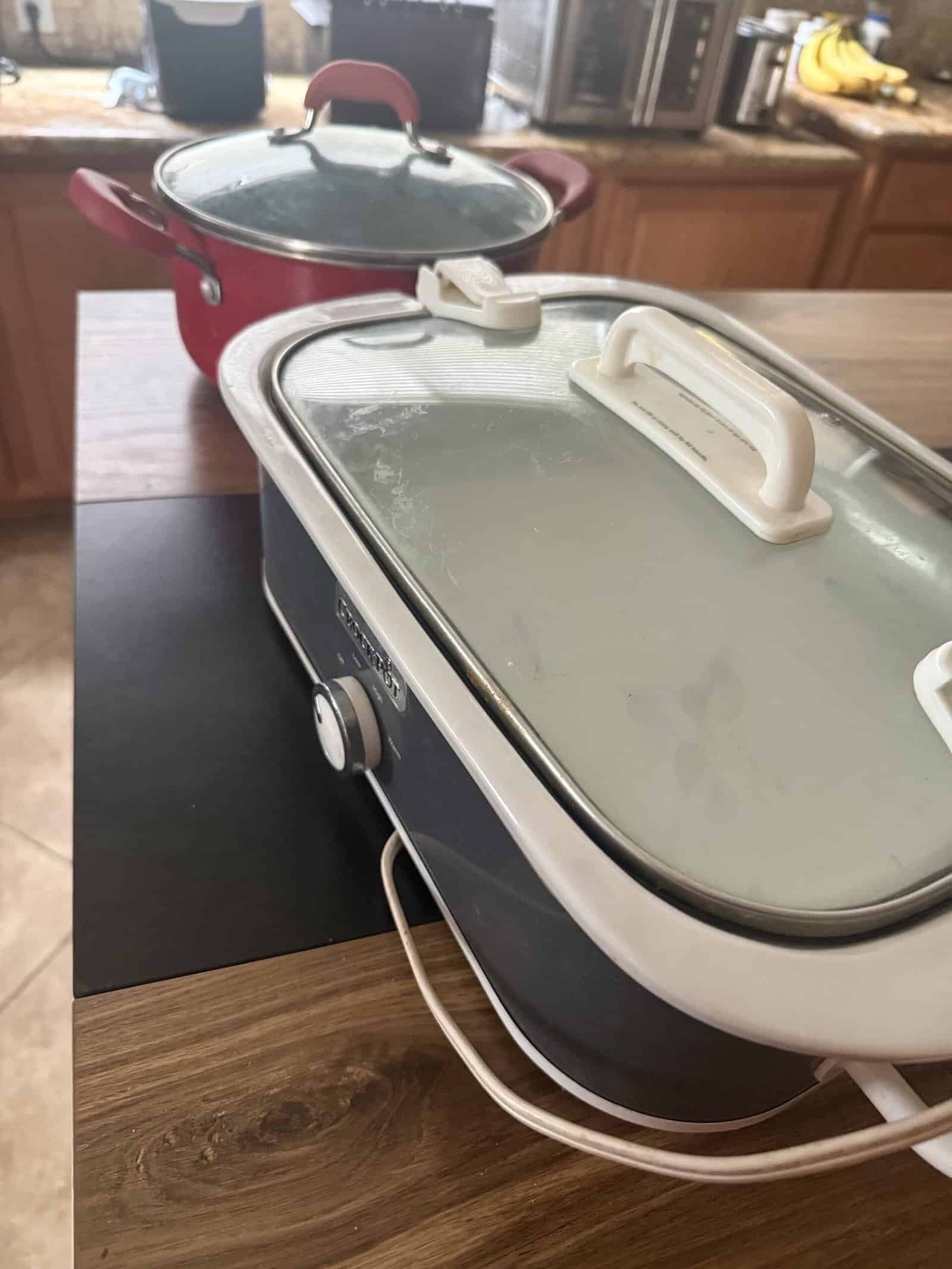
Soup gear articles have a habit of assuming you are making consommé. I am not. I make chicken noodle, chicken tortilla, and chili, and I make them in a Crock-Pot or a pot on the stove depending on what it is. That is the entire operation, and it turns out to need about four things, none of which is an immersion blender.
Quick Verdict
A slow cooker or a stockpot, depending on whether you want to leave it alone. A ladle. Containers for the leftovers, which is most of the soup. That is genuinely the list unless you are making purées, and most people are not.
Key Takeaways
- Slow cooker or stovetop pot. You do not need both, though both are useful.
- Soup is a leftovers dish. Storage matters as much as cooking.
- An immersion blender is for puréed soups only. Most soups are not puréed.
- Deli containers are the unglamorous right answer for storage.
- Volume is the thing to get right. Soup is worth making in quantity.
1. A Slow Cooker, Best Hands-Off Route
My default, and the reason soup happens on days when cooking would not.
I use a Crock-Pot for most of it. Chicken noodle, chicken tortilla, chili. Everything goes in, it runs for hours while I do something else, and the thing that makes it work is that nothing sticks or stains the insert, so the cleanup is not a punishment at the end.
The genuine advantage over a pot is not flavor, it is attention. A pot wants checking. A slow cooker wants nothing, and that difference decides whether you make soup on a weekday or order something.
I run mine during the day while I am around rather than overnight, which is a personal line rather than a rule. Programmable slow cookers covers the range, what to cook in one where soup is the safest bet, and cleaning one which matters less than you would think.
Best for: weekdays, batch quantities, anyone who does not want to stand there.
Skip if: you want to build flavor in stages, which needs a pot.
2. A Stockpot, Best for Control
The other half, and I use it when the soup wants a bit more from me.
A pot on the stove gives you stages: brown something first, build a base, adjust as you go, taste and fix. A slow cooker gives you one long uniform simmer, which is right for some things and flat for others.
It is also faster when you have not planned ahead, which is the honest reason a pot gets used more than the flavor argument suggests. Soup in ninety minutes beats soup in six hours when it is already five o’clock.
Size is the thing to get right, and bigger than you think is the correct instinct. Soup is a batch food and a pot that is too small caps how much you make. Stockpots covers sizing, and Dutch oven vs stockpot if you own one and are wondering about the other.
Best for: control, browning, soup you decided on an hour ago.
Skip if: you would rather not be in the kitchen. That is the slow cooker.
3. Deli Containers, Best Storage
The least exciting thing here and genuinely half of soup.
I use plastic deli containers. Not a matched set, not glass, not anything designed for the purpose. They stack, they are the same size so the lids interchange, they are cheap enough that losing one is not an event, and they hold a portion.
That last part is why they work. Soup is a leftovers dish. You make a lot and eat it over days, and the storage question is not aesthetic, it is how many portions you can get into a fridge tidily. Uniform containers stack; mismatched ones do not, and a fridge full of mismatched tubs is how soup gets forgotten and thrown out.
Meal prep containers covers the category, and food storage containers if you want the glass version, which is nicer and heavier and worse at this specific job.
Best for: portions, stacking, freezing, not caring.
Skip if: you want to reheat in the container and prefer glass for it.
4. A Ladle, Best Obvious Tool
Nobody writes a paragraph about a ladle, and you will notice its absence more than most things on this page.
The job is getting hot liquid from a deep pot into a bowl or a container without wearing it. A large spoon does this badly, a measuring cup does it badly and dangerously, and a ladle does it in one motion.
What to look for is a hook that actually sits on the pot rim, and a bowl deep enough to be worth the trip. Stainless outlasts everything and goes in the dishwasher, which matters for something that touches every batch.
One-piece is the version to buy. A ladle with a bonded handle traps liquid in the joint and that is where kitchen tools go to fail.
Best for: every soup, forever.
Skip if: you enjoy pouring from a stockpot. You do not.
5. A Cutting Board, Best Prep Surface
Soup is mostly chopping, which is easy to forget when the cooking is hands-off.
Chicken noodle is onion, carrot, celery, chicken. Chili is onion, pepper, garlic. Tortilla soup is much the same. That is a lot of prep going into a pot, and doing it on a small board means working in batches and pushing things around.
A big board is the fix and it is not subtle. Enough room to hold everything you have already cut means one pass instead of four. Mine is large and wooden, and the size does more for the job than the material does.
Wood is also kind to knives in a way glass and stone are not, which matters when you are cutting a pile of vegetables rather than one thing. Cutting boards covers the choice.
Best for: anything with more than two vegetables in it, which is all soup.
Skip if: you have counter space problems, where a thin board that stores upright wins.
6. A Chef’s Knife, Best Prep Tool
The other half of prep, and the one worth spending on.
Everything going into a soup gets cut by the same knife, and a dull one turns twenty minutes of chopping into a chore that makes you consider ordering instead. That is the real cost of a bad knife: not a worse result, a soup you did not make.
One good chef’s knife covers all of it. You do not need a set, and a soup does not care about your paring knife. Keep it sharp and it stays a pleasant twenty minutes rather than an argument.
Chef’s knives is where to spend, choosing one covers what matters, and why knives dull explains why yours is worse than it was.
Best for: all of it. This is the tool.
Skip if: you have one you like. Sharpen it instead.
Soup Gear at a Glance
| Item | Job | Needed? |
|---|---|---|
| Slow cooker | Hands-off soup | One of these two |
| Stockpot | Soup with control | One of these two |
| Deli containers | The leftovers, which is most of it | Yes |
| Ladle | Getting it out of the pot | Yes |
| Big board | All the chopping | Yes |
| Chef’s knife | All the chopping | Yes |
| Immersion blender | Puréed soups only | Probably not |
| Fine mesh strainer | Clarifying stock | No |
Slow Cooker or Stovetop
I use both and the choice is not really about the soup.
The slow cooker wins on attention. Everything goes in, it runs, you are elsewhere. That makes soup possible on days when standing over a pot would not happen, which is most days.
The pot wins on stages and on speed. If you want to brown something first, or taste and adjust twice, or eat in ninety minutes, that is a stove job. A slow cooker cannot brown and it cannot hurry.
For chicken noodle and chili either works. Chili is arguably better slow, because time does something to it. Chicken noodle is fine either way, and the noodles want adding late regardless of method or they turn to paste. Slow cooker vs Dutch oven covers the same argument from a different angle.
You Probably Do Not Need a Blender
Every soup gear list has an immersion blender near the top and I want to push back on it.
I do not use one. Not a stick blender, not a countertop blender, not for soup. Chicken noodle, chicken tortilla, and chili are all soups with things in them, and the entire point is that you can identify what you are eating.
An immersion blender is for puréed soups: butternut squash, tomato, potato leek. Those are real soups and if you make them, buy one. But the standard advice treats it as essential kit for anyone making soup at all, and for the soups most people actually make it is a tool that will sit in a drawer looking useful.
Which matters, because drawer space is finite and every specialist costs some of it permanently. Buy it when you make a purée and want it, not in advance.
Make More Than You Need
The one strategic point on this page.
Soup takes the same effort at double the volume. The chopping is marginally longer, the cooking is identical, and you end up with four portions instead of two. That is the highest return available in home cooking and it is why the storage section is not filler.
It also freezes well, which most food does not. Chili in particular is better later. That makes a batch of soup an investment in a future evening where you do nothing, and it is worth sizing your pot and your containers around that rather than around one dinner.
Meal prep containers is the practical end of this, and it is the difference between soup you eat and soup you find in three weeks.
Recommended Reading
See what to cook in a slow cooker, stockpots, and meal prep containers.
Soup Making Gear FAQ
What gear do I actually need to make soup?
A slow cooker or a stockpot, a ladle, a big board, a decent knife, and containers. That is it for the soups most people make. I make chicken noodle, chicken tortilla, and chili, and nothing on that list is missing.
Do I need an immersion blender for soup?
Only for puréed soups. I do not use one at all, because chicken noodle, tortilla soup, and chili are soups with things in them and the point is that they stay that way. If you make butternut squash or tomato soup, buy one then. It is not general soup equipment.
Slow cooker or stovetop pot?
Depends on attention. The slow cooker wins because you can be elsewhere, which is what makes soup happen on a weekday. The pot wins if you want to brown something first, adjust as you go, or eat in ninety minutes. I use both and the choice is about my day rather than the soup.
What is the best way to store soup?
Plastic deli containers, unglamorously. They stack, the lids interchange because they are all the same size, they hold a portion, and they are cheap. Soup is a leftovers dish and the real question is how many portions fit in a fridge tidily. Mismatched tubs are how soup gets forgotten.
What size stockpot do I need?
Bigger than you think. Soup is a batch food and it takes the same effort at double the volume, so a pot that is too small caps the main advantage. Eight quarts is a reasonable floor for anyone making soup on purpose.
Does soup freeze well?
Better than most food, and chili is arguably improved by it. That is what makes a batch worth it: same effort, four portions instead of two, and a future evening where you cook nothing.
Do I need a fancy pot?
No. Soup is the least demanding thing you can cook and almost any pot large enough will do it. Spend the money on the knife instead, since a dull knife turns twenty minutes of chopping into the reason you order takeaway instead.
When should I add the noodles?
Late, whichever method you use. Noodles in from the start turn to paste over hours, and that is true in a slow cooker and true in a pot left simmering. It is the one timing thing that matters in an otherwise forgiving dish.
Related in this cluster: our guide: how to organize your kitchen.
